The science of silence — from sound waves and destructive interference to the tiny microphones and processors that quiet the world around you.
Noise-cancelling headphones have become one of the most sought-after pieces of personal technology — staples of long-haul flights, busy open-plan offices, and crowded commutes. Yet despite their seemingly magical ability to hush the world, the science behind them is surprisingly elegant. Two distinct mechanisms work in concert: a physical one, built into the shape and materials of the headphone itself, and an electronic one that actively fights noise with noise. Understanding both will help you get more out of your pair — and set realistic expectations for what they can, and cannot, do.
What Are Noise-Cancelling Headphones?
At their simplest, noise-cancelling headphones are headphones designed to reduce the amount of unwanted ambient sound that reaches your ears. But that description covers a wide range of products that work in very different ways.
A standard pair of headphones makes no attempt to block outside sound — the music simply competes with it. Passive noise-isolating headphones use physical design (thick ear cups, dense padding, tight-sealing ear tips) to muffle external noise before it reaches your ear, much like an earplug would. Active noise-cancelling (ANC) headphones go further: they use microphones and electronics to detect ambient sound and generate a countering signal that cancels it out.
In practice, every ANC headphone also relies on passive isolation. The two mechanisms complement each other, targeting different types and frequencies of noise. Typical use cases include air travel, public transport, shared workspaces, study environments, and anywhere that background drone makes listening — or thinking — harder than it should be.
The Basics of Sound and Noise
Sound Waves and Frequency
Sound is pressure — specifically, rapid variations in air pressure that radiate outward from a vibrating source like a speaker cone, an engine, or a human voice. These variations form waves, characterised by two key properties.
Frequency describes how many wave cycles occur per second (measured in hertz, Hz) and corresponds to what we perceive as pitch: low frequencies are bass rumbles, high frequencies are sharp trebles. Amplitude describes how large the pressure variations are, which we experience as loudness.
A third property — phase — describes where a wave is in its cycle at any given moment. Two waves of the same frequency can be “in phase” (their peaks and troughs aligned) or “out of phase” (one’s peak meeting the other’s trough). This distinction is the foundation of active noise cancellation.
How Destructive Interference Cancels Sound
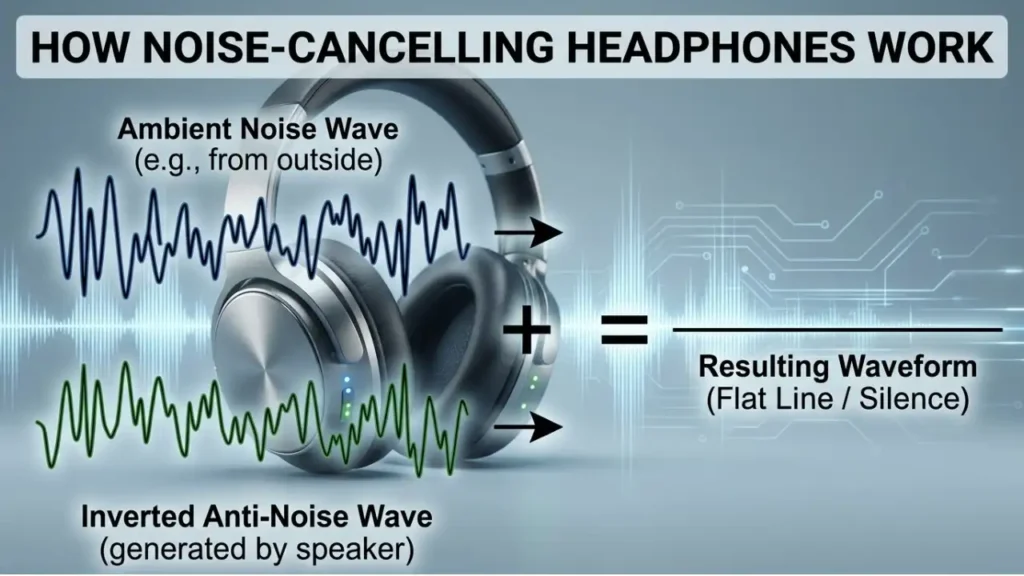
When two sound waves occupy the same space at the same time, they add together. If both waves have their peaks aligned, they reinforce each other and the sound gets louder — this is constructive interference. But if one wave’s peak aligns with the other’s trough, they partially or completely cancel each other out. This is destructive interference.
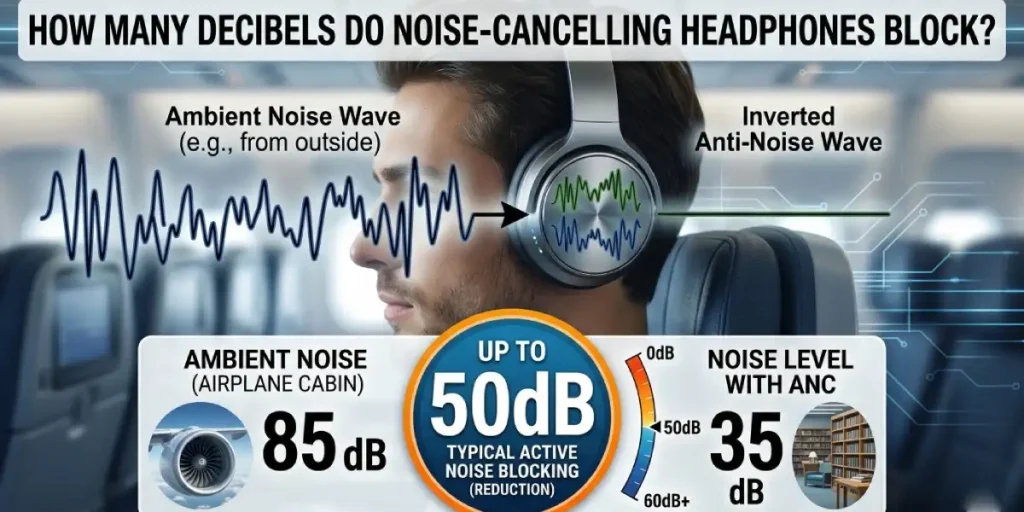
Noise-cancelling headphones exploit this principle deliberately. They generate an “anti-noise” signal — a wave identical in amplitude to the incoming noise but precisely inverted in phase. When the original noise and the anti-noise meet at your ear, they subtract each other, and the result is greatly reduced sound.
Passive Noise Isolation: The First Line of Defense
How the Physical Design Blocks Sound
Before any electronics get involved, the physical construction of a noise-cancelling headphone is already doing significant work. Over-ear headphones use large, padded ear cups made from memory foam or similar dense materials to form a seal around the ear, essentially turning the space between the driver and your eardrum into a closed acoustic chamber. In-ear models achieve the same effect with silicone or foam ear tips that press gently against the walls of the ear canal.
This works in the same way as earplugs or protective earmuffs — sound energy is absorbed and reflected by the material rather than transmitted through it. No electronics required.
When Passive Isolation Works Best
Passive isolation is most effective at mid-to-high frequencies — sharp consonants in speech, the clatter of keyboards, the clink of cutlery, or the high-pitched hiss of a nearby conversation. These sounds have short wavelengths that are physically blocked by solid materials.
This is also why fit matters enormously. A headphone that doesn’t seal properly against your head, or ear tips that are the wrong size for your ear canal, will leak sound around the edges and undermine the passive isolation — and by extension, the performance of the ANC system built on top of it.
Active Noise Cancellation: The Electronic Magic
Step-by-Step: How ANC Works
Active noise cancellation is a real-time electronic process. Every component in the signal chain matters: microphones, a digital signal processor, and the headphone’s own speaker drivers all play a role.
- Microphones capture ambient noise. One or more microphones, positioned on the outside of the ear cup or earbud, continuously sample the sound environment around you.
- The DSP analyses the noise signal. A digital signal processor (DSP) — a small, fast chip inside the headphone — receives this audio, measures its frequency pattern and phase in real time.
- An inverted anti-noise wave is generated. The DSP calculates and produces a signal that is the mirror image of the incoming noise: same amplitude, opposite phase.
- The drivers play your audio and the anti-noise together. The headphone’s speakers combine your music with the anti-noise signal and play both simultaneously.
- Destructive interference does the rest. At your eardrum, the real ambient noise and the anti-noise wave collide and largely cancel each other out, leaving your audio — or quiet — intact.
The whole process happens in milliseconds — fast enough to keep up with the constantly changing noise environment around you.
Learn More: Active vs Passive noise cancelling
Why ANC Loves Low-Frequency Noise
Noise-cancelling headphones are remarkably effective at certain sounds — and noticeably less so at others. The reason comes down to the nature of the noise itself. Low-frequency sounds like a jet engine’s roar, the rumble of a train carriage, or the drone of an air conditioning unit are characterised by long, slow-moving pressure waves that repeat in a predictable, consistent pattern. These are easy for the DSP’s algorithm to model accurately and cancel in real time.
High-frequency sounds — a nearby sneeze, a burst of laughter, the sharp click of a keyboard — have very short wavelengths and change rapidly and unpredictably. By the time the DSP has sampled the noise, calculated an inverse wave, and played it back, the original sound has already moved on. The algorithm can’t keep up, so the cancellation is far less complete at these frequencies.
KEY INSIGHT
ANC is excellent at removing the steady, low-pitched drone of engines and HVAC systems. It is much less effective against speech, sudden impacts, or high-pitched irregular sounds — not because of poor engineering, but because of the fundamental physics of how sound waves behave at different frequencies.
Different Types of ANC Systems
Feedforward ANC
In a feedforward system, the microphones are placed on the outside of the ear cup or earbud — facing the world. They detect ambient noise before it has passed through the headphone casing and reached your ear, giving the DSP a “preview” to work with.
Advantages: Early detection means more processing time; effective at cancelling predictable external noise; works independently of the driver’s output.
Limitations: Sensitive to wind noise; less adaptive to changes inside the ear cup; performance can vary with small positional shifts.
Feedback ANC
A feedback system places the microphone inside the ear cup, close to your ear. Rather than sampling external noise before it enters, it measures the combined signal — music plus any residual noise — at the point just before it reaches your eardrum, and continually adjusts the anti-noise output to compensate.
Advantages: Corrects for fit issues and seal imperfections; accounts for variations between individual driver units; responds to what the listener actually hears.
Limitations: More complex to tune without affecting music signal; potentially narrower effective frequency range; reacts after noise has partially entered the ear cup.
Hybrid ANC
Most premium modern headphones and earbuds use a hybrid approach, combining both feedforward and feedback microphones. The feedforward mic catches external noise early; the feedback mic verifies what actually reaches the ear and fine-tunes the cancellation. The result is broader frequency coverage, better performance across varied environments, and greater resilience to fit differences. Hybrid ANC is now the standard in flagship consumer products.
Adaptive and Adjustable ANC
Adaptive Noise Cancellation
Some headphones go beyond a fixed ANC profile and use adaptive noise cancellation algorithms that automatically adjust their behaviour based on what the microphones are detecting. In a quiet library, the system might run at a reduced level to avoid side effects like the pressure sensation described later. Boarding a noisy aircraft, it ramps up intensity without any input from you. This can also be managed through a companion smartphone app, with “modes” tailored to specific environments.
Manual ANC Levels and Modes
Many headphones also offer user-selectable ANC levels — typically low, medium, and high — allowing you to dial in the amount of cancellation that makes sense for your situation.
- High ANC on a transatlantic flight makes obvious sense.
- Medium ANC in a shared office lets you block the HVAC drone while remaining more aware of what’s around you.
- At home, you may prefer ANC off entirely to preserve battery life and enjoy a more natural sound.
Transparency and Ambient Sound Modes
Why Sometimes You Want Noise Let In
Effective noise cancellation creates a remarkable bubble of quiet — but there are situations where that bubble is genuinely dangerous, and others where it’s simply inconvenient. Crossing a street without hearing approaching traffic, missing your station announcement on the train, or needing a brief word with a colleague — these are all reasons why most ANC headphones now include a transparency mode (also called ambient sound mode).
How Transparency Mode Works
In transparency mode, the headphone’s external microphones capture the surrounding environment and pass that audio through to your ears — mixed with or instead of the ANC signal. Done well, you can hold a conversation or navigate a busy street while still wearing your headphones. There’s usually a slight processed quality to the sound, but it’s a practical and increasingly well-implemented feature, and a good reason to use headphones thoughtfully rather than leaving them on maximum ANC at all times.
Limits and Side Effects of Noise-Cancelling Headphones
What ANC Can’t Do Well
ANC is not a blanket mute button. It is optimised for constant, low-frequency, and predictable sounds. The following are genuinely difficult for even the best ANC systems to address fully:
- The voice of a person sitting immediately next to you
- A baby crying in the row behind you on a plane
- Sudden impacts — a door slamming, dishes clattering
- High-pitched irregular sounds like keyboard clicks or glass chinking
- Wind noise (which can actually be amplified by external microphones)
These aren’t failures of design — they are the natural limits imposed by physics and the constraints of real-time digital signal processing.
Common Sensations and Issues
Some people experience a noticeable pressure sensation when using ANC — a feeling sometimes described as the ears “popping” or a mild fullness, similar to a change in altitude. This is caused by the altered air pressure dynamics inside a sealed ear cup combined with the anti-noise signal, rather than any hearing damage. It is more pronounced in some people than others, and typically fades with regular use.
You may also notice a very faint electronic hiss in extremely quiet environments, produced by the ANC circuitry itself. This is audible only when you’re in near-silence with no audio playing — during normal listening it is completely inaudible.
Finally, some headphones tune their audio characteristics slightly differently depending on whether ANC is on or off, which can affect the perceived sound quality. The most accomplished modern designs minimize this difference.
Battery Drain
ANC requires power — the microphones, DSP, and additional circuitry all draw from the battery. On most modern headphones, enabling ANC reduces battery life by roughly 20–40% compared to listening with ANC off, though exact figures vary widely by model. It’s a meaningful trade-off on long journeys, and worth keeping in mind when packing for a trip.
Safety and Hearing Health
One often-overlooked benefit of effective ANC is that it can encourage more sensible listening volumes. When you no longer need to compete with a roaring jet engine or rush-hour traffic, you naturally reach for a lower volume — which is genuinely better for your long-term hearing. That said, even with ANC, listening at very high volumes for extended periods remains harmful. The headphones reduce external noise; they do not protect your ears from the music itself.
Practical Examples and Use Cases
| SCENARIO 01 On a Plane |
| This is where ANC first made its name, and still where it earns it most decisively. Aircraft cabin noise is dominated by low-frequency engine rumble and the constant white-noise hiss of pressurised air circulation — both of which sit squarely in ANC’s sweet spot. A good pair of ANC headphones can reduce perceived cabin noise to a remarkable degree. |
| The voice of a passenger next to you will still be partly audible, and sudden sounds like trolley wheels or announcements will get through. But the overall combination of passive isolation plus active cancellation creates an acoustic environment far quieter than the cabin itself. |
| SCENARIO 02 In a Noisy Office or Café |
| Open-plan offices and busy cafés present a mixed noise environment: constant HVAC drone, the general murmur of nearby conversations, and the occasional sharp interruption of a raised voice or dropped object. ANC handles the former well and the latter less so. |
| The practical benefit is not silence but reduced fatigue. Removing the constant background drone — even imperfectly — makes concentration easier over a full working day. Many workers use ANC headphones less for the audio itself and more as a fatigue reducer and do-not-disturb signal. |
| SCENARIO 03 On Public Transport and in the City |
| Trains, buses, and underground metros produce a rich mixture of wheel noise, engine vibration, and general din — most of it in the low-to-mid frequency range where ANC performs strongly. City street noise — traffic rumble, distant sirens — is similarly well-addressed. |
| However, this is also where transparency mode becomes important. When crossing the road, cycling, or navigating somewhere unfamiliar, switching to transparency mode lets you hear traffic, announcements, and people around you without removing your headphones. |
Check Out:
ANC headphones for airplanes and long flights
ANC headphones for office and work
Choosing Noise-Cancelling Headphones
Understanding how the technology works puts you in a better position to evaluate what actually matters when choosing a pair — beyond the marketing claims.
| FACTOR | WHY IT MATTERS | BEST FOR |
|---|---|---|
| ANC quality | How much low-frequency noise is actually reduced in real-world conditions | Frequent travellers, commuters |
| Fit and seal | Determines passive isolation and therefore the effectiveness of ANC on top | Everyone — especially in-ear users needing the right tip size |
| Sound quality | How the headphone sounds with and without ANC engaged | Audiophiles and critical listeners |
| Battery life | ANC shortens battery life; important for long-haul travel | Travellers, field workers |
| Transparency mode | Quality matters — poor implementation sounds unnatural | Cyclists, urban commuters, safety-conscious users |
| Comfort and weight | Passive isolation requires a firm seal, which means some clamp force | Long listening sessions, travel |
| App and controls | ANC modes, EQ, and adaptive settings are increasingly app-driven | Power users who want to customise |
Matching ANC to Your Use Case
A frequent traveller should prioritise strong low-frequency cancellation and long battery life. An office worker benefits from good ANC balanced with a high-quality transparency mode for quick conversations. A student or home user may find that mid-range ANC performance is entirely sufficient; fit, comfort, and price often matter more at this use case than peak cancellation performance.
The Science Behind the Silence
Effective noise cancellation is never a single trick — it is a layered system of physical design and electronic intelligence working in concert. The key principles to take away:
- Passive isolation uses physical materials to block sound, especially at mid-to-high frequencies.
- Active noise cancellation uses microphones and a DSP to generate anti-noise waves that cancel ambient sound via destructive interference.
- ANC is most effective at constant, low-frequency sounds like engine and HVAC rumble.
- High-frequency, sudden, or irregular sounds are harder to cancel — by physics, not by oversight.
- Hybrid ANC systems, combining feedforward and feedback microphones, deliver the broadest and most reliable cancellation.
- Fit and seal remain essential — even the best ANC cannot compensate for a headphone that doesn’t seal properly.
- Transparency mode turns the microphone system into a pass-through for situational awareness.
- Side effects — pressure sensation, faint hiss, battery drain — are manageable and vary by model.
These systems are optimised for certain types of noise in certain situations. They won’t deliver total silence in every environment. But used in the right context, they remain one of the most practically impactful pieces of audio technology available today.

I am the founder of Sound Mavericks, where I provide the polite truth about audio equipment. I started this site because consumer electronics reviews are often too technical. Instead of using a silent lab, I test headphones, earbuds, and Bluetooth speakers in the real world – like on a noisy subway or in a busy coffee shop.
To stay independent, I buy my own review units (mostly from the United States) rather than accepting free gifts from brands. Once I finish testing a product, I sell it locally to our community. My goal is to help you understand sound quality, active noise cancellation (ANC), and battery life without the marketing hype.