
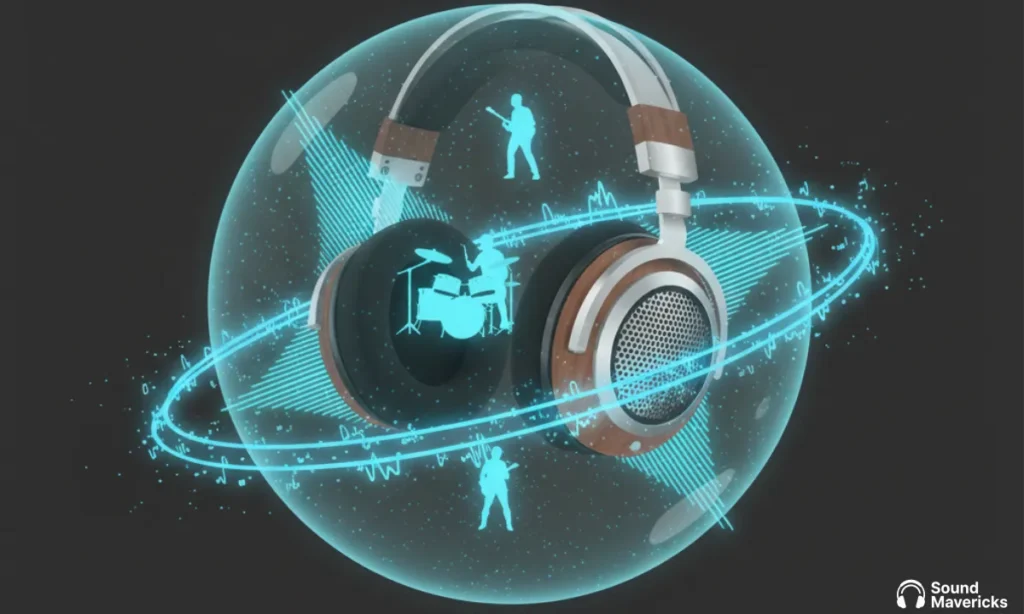
Have you ever put on a pair of cheap earbuds and felt like the music was originating from the exact center of your skull? The singer feels trapped inside your head, and the instruments feel jammed together in a tight line between your ears.
Now, imagine putting on a different pair of headphones. Suddenly, the pressure lifts. The singer sounds like they are standing five feet in front of you. The drummer sounds like they are behind the singer. You can hear the guitar coming from the far left, almost as if it’s outside the headphone cup.
That magical difference is Soundstage.
In simple terms, Soundstage is the perceived three-dimensional space where your music lives. It is the difference between listening to a band in a broom closet and listening to them in a concert hall.
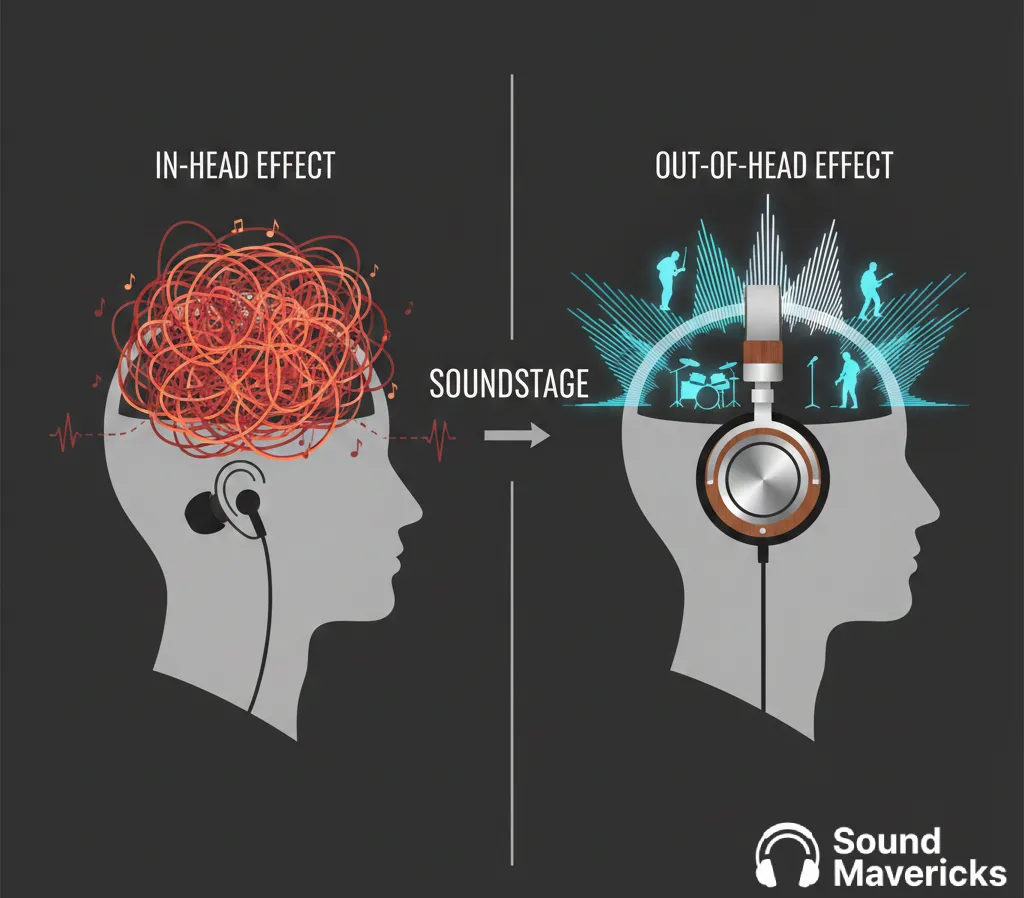
The In-Head vs. Out-of-Head Effect
To understand soundstage, you first have to accept that headphones are naturally wrong.
When you listen to speakers in a room, your right ear hears the right speaker, but it also hears a little bit of the left speaker a split second later. This is called cross-feed, and it helps your brain calculate distance and space.
Headphones break this rule. They isolate your ears. The left ear hears only left, and the right ear hears only right. Without those natural room cues, your brain gets confused and defaults to placing the sound inside your head. This is the In-Head effect.
A headphone with good soundstage tricks your brain. It uses clever engineering to pull that sound out of your head and push it into the room around you.
- Narrow Soundstage: The music happens strictly between your ears. It feels intimate but claustrophobic.
- Wide Soundstage: The music creates a sphere around you. It feels like you are wearing two speakers on your shoulders, rather than tiny drivers pressed against your ears.
The 3 Dimensions of Sound
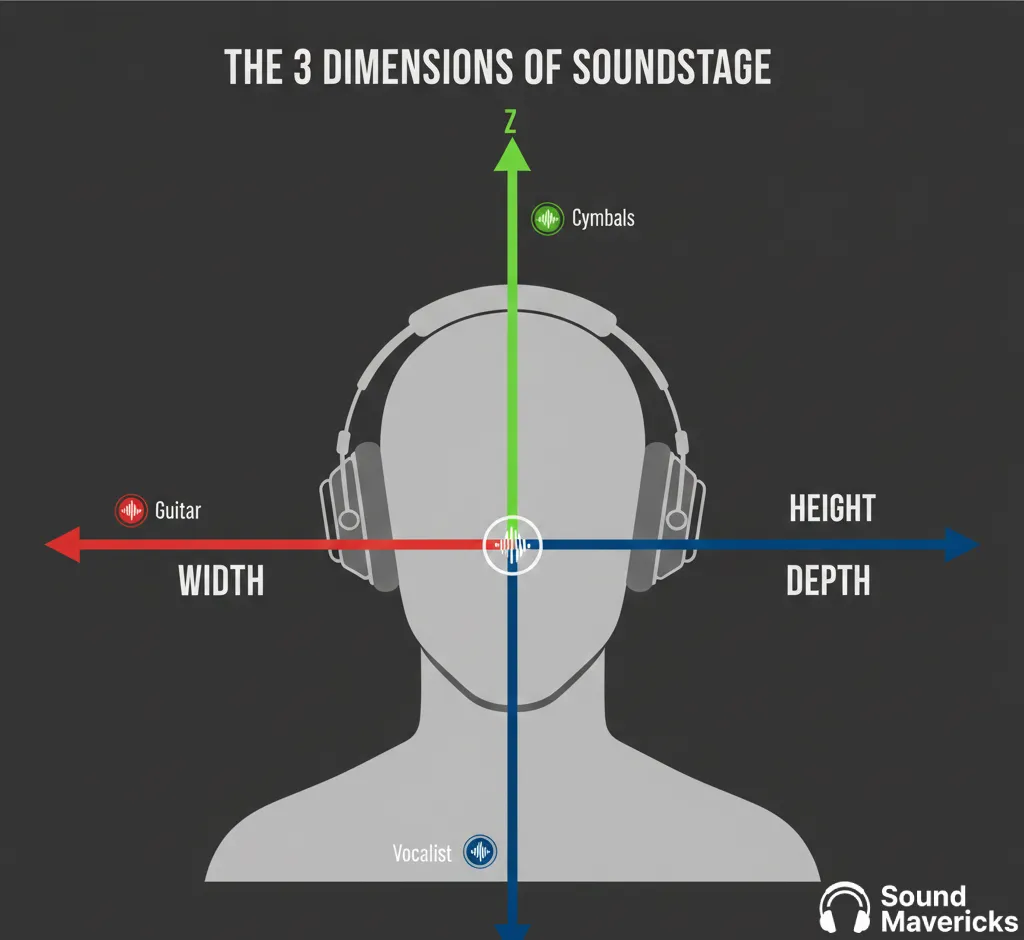
Many people think soundstage is just about how wide the sound is. But a true audiophile looks at three distinct dimensions. Think of it like a 3D graph.
1. Width (The X-Axis)
This is the most common metric. How far left and right does the sound extend?
- Poor Width: The guitar sounds like it is touching your ear.
- Great Width: The guitar sounds like it is coming from the walls of the room you are sitting in.
2. Depth (The Y-Axis)
This is much harder to achieve. Depth is the distance from your nose forward. Can you hear layers in the music?
- Poor Depth: The singer and the drummer sound like they are standing on the same line, flat against your face.
- Great Depth: You can clearly hear that the vocalist is close, the drums are five feet back, and the string section is ten feet back. It creates a holographic effect.
3. Height (The Z-Axis)
This is the rarest quality. Does the sound have verticality?
- Poor Height: Everything is at eye level.
- Great Height: You can hear the shimmer of a cymbal floating above the rest of the mix, or the deep rumble of bass feeling low in the mix.
Soundstage vs. Imaging (The Crucial Distinction)
This is where 90% of beginners get confused. You will often hear reviews say, “These headphones have a huge stage, but bad imaging.”
Here is the difference:
- Soundstage is the size of the room.
- Imaging is how accurately you can point to the instruments in that room.
The Empty Gym Analogy: Imagine you are blindfolded in a massive gymnasium. Someone throws a basketball against the wall.
- Big Soundstage: You can tell the gym is huge because the echo takes a long time to bounce back. You feel the space.
- Good Imaging: You can point your finger and say, The ball hit the wall exactly there.
The Matrix:
- Big Stage + Bad Imaging: It sounds like a large, blurry wall of sound. It is atmospheric and fun, but you can’t pick out specific details.
- Small Stage + Good Imaging: This is common in studio monitors. You can pinpoint every mistake in the mix, but it sounds dry and clinical.
- Big Stage + Good Imaging: This is the Holy Grail. You are in a big concert hall, and you know exactly where every musician is sitting.
What Creates a Massive Soundstage?
Why do some headphones sound huge while others sound tiny? It usually comes down to three physical factors.
1. Open-Back vs. Closed-Back
This is the single biggest factor.
- Closed-Back: These have a solid cup on the outside. Sound waves bounce off your ear, hit the plastic cup, and bounce back. This creates reflections that clutter the sound, making the room feel small.
- Open-Back: These have grills or mesh on the outside. Sound waves pass through the driver and escape into the room. Because there are no reflections bouncing back, your brain perceives the space as open and airy. If you want soundstage, you buy open-back headphones.
2. Angled Drivers
Standard headphones place the speaker flat against your ear. However, in the real world, sounds usually come from in front of you. High-end headphones (like the Sennheiser HD 800 S) physically angle the driver so the sound creates a reflection on your outer ear (pinna) before entering your ear canal. This tricks your brain into thinking the sound is coming from speakers in front of you.
3. Frequency Tuning (The Air)
Our brains associate high-frequency sounds (treble) with open space. Headphones that boost the Air frequencies (usually above 10,000 Hz) will artificially sound wider. Headphones with too much bass often sound closed in, because bass frequencies are thick and fill up the space.
Real World Test: When Do You Actually Need It?
You might think bigger is always better, but that is not true. Here is who actually needs soundstage.
The Gamer (FPS vs. Immersion)
- Competitive FPS (Call of Duty/CS: GO): You actually do not want a massive soundstage. If the stage is too wide, footsteps sound distant and vague. You want Imaging over Soundstage. You need to know exactly where the enemy is, not feel the atmosphere of the map.
- Open World (Elden Ring/Skyrim): You want huge soundstage. You want to hear the wind howling across the plains and feel the scale of the world.
The Music Listener
- Live Recordings & Classical: You need soundstage. These genres are recorded in real spaces. You want to recreate the venue.
- Pop & Hip Hop: Soundstage matters less. These genres are often synthesized and mixed to sound “in your face.” Too much soundstage can make intimate vocals feel distant and weak.
The Buying Guide (2026 Picks)
If you are ready to chase the wide sound, here is exactly what you should look at.
1. The King of Stage: Sennheiser HD 800 S This is the benchmark. If you have the money, this is the widest headphone on the market. It sounds like you are wearing speakers, not headphones. It is expensive, but it defines this category.
2. The Value Pick: Hifiman Edition XS This uses Planar Magnetic drivers which are very tall. This gives you a massive sense of scale and height for a fraction of the price of the HD 800 S.
3. The Budget King: Sennheiser HD 560S If you are just starting out, buy this. It offers a surprisingly open and accurate stage for the price. It beats almost every gaming headset on the market.
4. The Gamer’s Choice: Audeze Maxwell This is a rare closed-back wireless headset that actually manages decent soundstage. It won’t beat an open-back, but if you need isolation and wireless connectivity, this is the best compromise.
Frequently Asked Questions
Only slightly. You can boost the treble to add a sense of air, which mimics a wider stage. However, you cannot fix the physics of the driver. If the headphones are closed and narrow, EQ cannot turn them into a concert hall.
No. Virtual 7.1 is software that distorts the audio signal to trick your brain. It often makes the audio sound tinny, echoey, and fake. A good stereo headphone with natural soundstage is almost always better than cheap headphones using 7.1 software.
Generally, no. Because they bypass your outer ear entirely, it is very difficult for IEMs to create a sense of space. The sound usually happens strictly between your ears. There are very expensive exceptions (like the Sony IER-Z1R), but generally, if you want stage, you need full-size headphones.
Often, yes. While the headphones themselves do 90% of the work, a weak power source (like a phone dongle) can make the audio sound congested. A good amplifier provides cleaner power, which improves channel separation (keeping left and right sounds distinct). Better separation tricks your brain into perceiving a wider, more organized space.
It is likely the recording, not the headphones. You cannot widen a song that was mixed to sound narrow. Modern Pop and Rock are often mixed to sound in your face and loud, with very little depth. If you want to test your headphones, try listening to a live Jazz recording or an Orchestral track. If the stage is still small, then blame the headphones.
No. Physics always wins. Speakers use the actual room you are sitting in, and the sound waves hit your entire body, not just your ears. Headphones are strictly a simulation of that experience. However, headphones are much better at Imaging (detail placement) because they remove the echoes and bad acoustics of your room.

I am the founder of Sound Mavericks, where I provide the polite truth about audio equipment. I started this site because consumer electronics reviews are often too technical. Instead of using a silent lab, I test headphones, earbuds, and Bluetooth speakers in the real world – like on a noisy subway or in a busy coffee shop.
To stay independent, I buy my own review units (mostly from the United States) rather than accepting free gifts from brands. Once I finish testing a product, I sell it locally to our community. My goal is to help you understand sound quality, active noise cancellation (ANC), and battery life without the marketing hype.