Buying headphones used to be simple. You bought the big ones for your house and the small ones for your Walkman. Today, the market is crowded. You see terms like IEMs, Open-Fit, and Circumaural thrown around, and it is easy to get confused.
The biggest mistake people make is thinking that Earbuds and In-Ear headphones are the same thing. They are not. They fit differently, they sound different, and they are built for completely different lifestyles.
If you buy the wrong type, you might end up with headphones that hurt your ears after 30 minutes, or ones that fall out every time you run for a bus. This guide will break down the three main styles so you can stop guessing and start listening.
In-Ear vs. Earbuds vs. Over-Ear in Simple Terms
Before we look at the technology, we need to agree on what these things actually are.
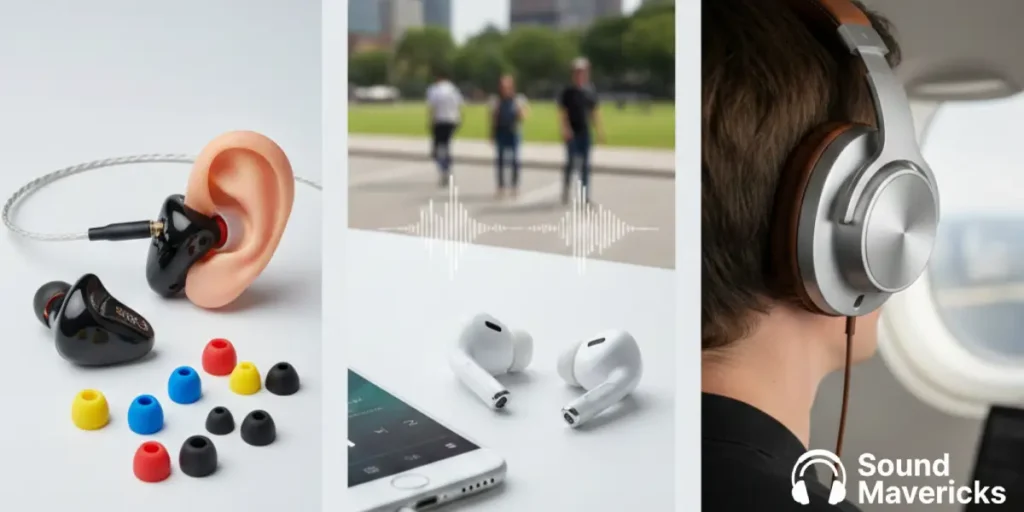
- In-Ear Monitors (IEMs): These have soft tips (silicone or foam) that go inside your ear canal. They plug your ear like a cork in a bottle.
- Earbuds: These sit loosely in the outer part of your ear (the concha). They do not seal the canal. Think of the original wired Apple EarPods.
- Over-Ear Headphones: These have large cups that go completely around your ears. The padding rests on your head, not your ears.
The Seal is Everything
The most important difference is the seal.
In-Ears create a physical barrier between you and the world. This traps the air inside your ear canal. Because the air is trapped, the bass feels stronger and punchier.
Earbuds do not seal. They let air flow in and out. This makes the music sound more open or natural, like you are listening to speakers in a room. However, because the air escapes, you lose a lot of deep bass.
Over-Ears create a seal around your entire ear. This gives you the best of both worlds: good bass and a big, wide sound.
How They Actually Work
In-Ear Headphones (The Plug)
In-ear headphones are built for isolation. When you push that silicone tip into your ear, you are creating Passive Noise Isolation.
Think of this like plugging your ears with your fingers. Even without a battery or fancy technology, the rubber tip blocks out a lot of outside noise simply by being there. This is great for sound quality. Because the speaker is millimeters from your eardrum, you can hear tiny details very clearly.
The Downside: The main issue is comfort. Some people hate the feeling of having an object inside their ear canal. It can feel invasive. Also, there is something called the Occlusion Effect. This is when you hear your own voice, chewing, or footsteps booming inside your head because your ears are plugged. If you eat lunch while wearing these, it sounds very loud.
Earbuds (The Open Window)
Earbuds are the opposite of In-Ears. They sit on the ledge of your outer ear. Because they don’t block the canal, you can still hear the world around you.
This is a safety feature. If you are walking in a busy city, you want to hear a car honking or a bike bell. Earbuds let that sound in. They are also usually more comfortable for long listening sessions because there is no pressure inside your ear.
The Downside: The lack of a seal destroys bass. Low-frequency sounds (bass) need pressure to work. With earbuds, the pressure leaks out. If you love Hip-Hop or EDM, earbuds will often sound thin or tinny compared to the other two styles.
Over-Ear Headphones (The Soundstage)
These are the heavyweights. Because the cups are big, engineers can put massive drivers (speakers) inside them—usually 40mm or larger.
Big drivers move more air effortlessly. This creates a sense of Soundstage. Soundstage is the feeling that the music is happening around you, not just inside your head. Over-Ears are excellent for movies and orchestral music because they can reproduce that cinematic feeling.
The Downside: Heat. We call it hot ears. Over-ear headphones act like earmuffs. If you wear them for two hours in a warm room, your ears will sweat. They are also bulky. You cannot just shove them in your pocket; you need a bag.
Scenario Tests: Real World Performance
Theoretical specs are fine, but how do these perform when you actually use them?
Scenario A: The Daily Commute (Train/Bus)
The Winner: Over-Ear (with ANC) or In-Ear. The Loser: Earbuds.
On a noisy train, earbuds are useless. The engine noise will mix with your music. To hear the song, you will turn the volume up to 100%, which damages your hearing.
You need a seal here. In-Ears block the noise physically. Over-Ears with Active Noise Cancellation (ANC) are even better. They use microphones to listen to the engine roar and produce a counter-sound to cancel it out. It is like a magic eraser for noise.
Scenario B: The Gym & Running
The Winner: In-Ears. The Loser: Over-Ears.
Over-ear headphones are heavy. If you run, they will bounce. If you lift weights, they might slide off when you lie down on the bench. Worse, the leather pads will soak up sweat and start to smell bad very quickly.
In-Ears lock into place. Many sports models have fins or wings to keep them secure. They are lightweight and often water-resistant.
Scenario C: The Office / Working From Home
The Winner: Over-Ears. The Loser: In-Ears.
For an 8-hour shift, comfort is king. In-Ears can irritate your ear canal after 3 or 4 hours. It starts to feel like an itch you can’t scratch.
Over-Ear headphones distribute the weight across your head. Good ones have memory foam pads that feel like pillows. You can wear them all day without pain. Just make sure to take them off during lunch to let your ears breathe.
The Buying Guide: Who Should Buy What?
Stop reading reviews for a moment and look at your daily routine. That will tell you what to buy.
Buy In-Ear Headphones If:
- You want powerful bass and isolation in a small package.
- You commute on public transport but don’t want to carry a big bag.
- You exercise regularly and need sweat resistance.
Buy Earbuds If:
- You hate the feeling of pressure in your ears.
- You listen to podcasts or audiobooks more than music.
- You need to stay aware of your surroundings (e.g., watching kids or walking in traffic).
Buy Over-Ear Headphones If:
- Sound quality is your number one priority.
- You listen at a desk or on a couch for long periods.
- You fly frequently (Over-Ear ANC is still the best for airplanes).
Frequently Asked Questions (FAQ)
Generally, yes. Because Over-Ears block outside noise effectively (passive isolation), you don’t feel the need to crank the volume up to dangerous levels. With earbuds, people often turn the volume up to drown out the world, which hurts their hearing over time.
This is usually a size issue. Most In-Ears come with Small, Medium, and Large tips. If you use a tip that is too big, it puts constant pressure on your sensitive ear canal skin. Try switching to a smaller size or buying Comply foam tips, which are softer than silicone.
Some companies try, but it rarely works well. ANC needs a good seal to function properly. Without a seal, the noise leaks in anyway. Open ANC usually just reduces a bit of low hum but won’t silence a room.
Over-Ears win easily. They have more physical space for large batteries. Many Over-Ears can last 30 to 60 hours on a single charge. In-Ears and Earbuds are tiny, so they usually last 5 to 8 hours before they need to go back in their charging case.
Sometimes, yes. Because In-Ears seal the canal, they can pressurize the air very efficiently. This creates a thump that feels very powerful. However, high-end Over-Ears usually have better quality bass (more detail), even if it doesn’t thump as hard as a sealed In-Ear.
On-Ear headphones sit directly on your ear cartilage rather than around it. We generally do not recommend them at Sound Mavericks. They often pinch your ears, causing pain after an hour, and they don’t isolate noise as well as Over-Ears or In-Ears. They are a compromise that rarely satisfies anyone.
You can, but it’s risky. Sweat is corrosive. It will eventually crack the leather pads and can damage the electronics inside the cups. If you must wear big headphones at the gym, look for ones specifically made with breathable mesh fabric, not leather.

I am the founder of Sound Mavericks, where I provide the polite truth about audio equipment. I started this site because consumer electronics reviews are often too technical. Instead of using a silent lab, I test headphones, earbuds, and Bluetooth speakers in the real world – like on a noisy subway or in a busy coffee shop.
To stay independent, I buy my own review units (mostly from the United States) rather than accepting free gifts from brands. Once I finish testing a product, I sell it locally to our community. My goal is to help you understand sound quality, active noise cancellation (ANC), and battery life without the marketing hype.