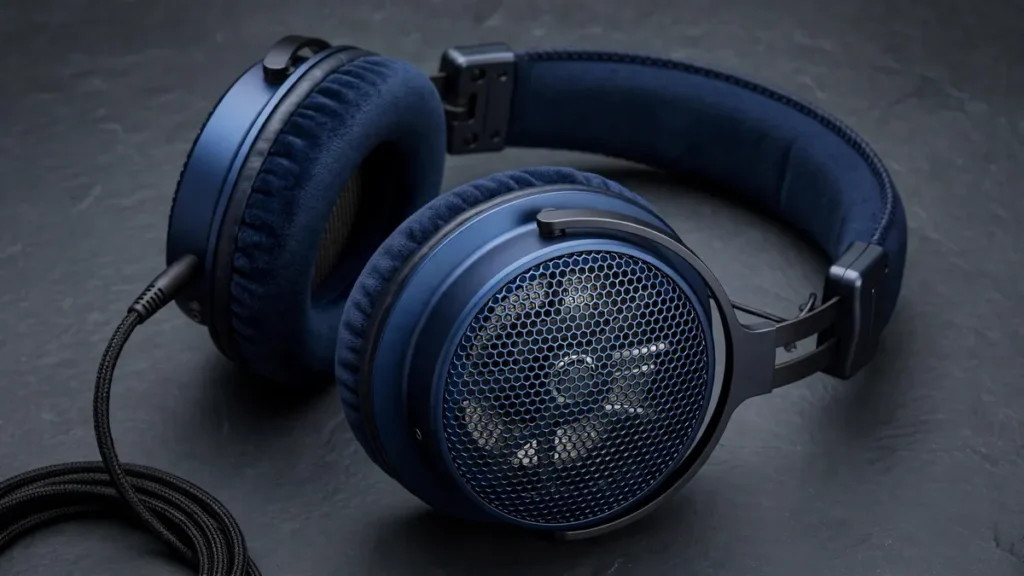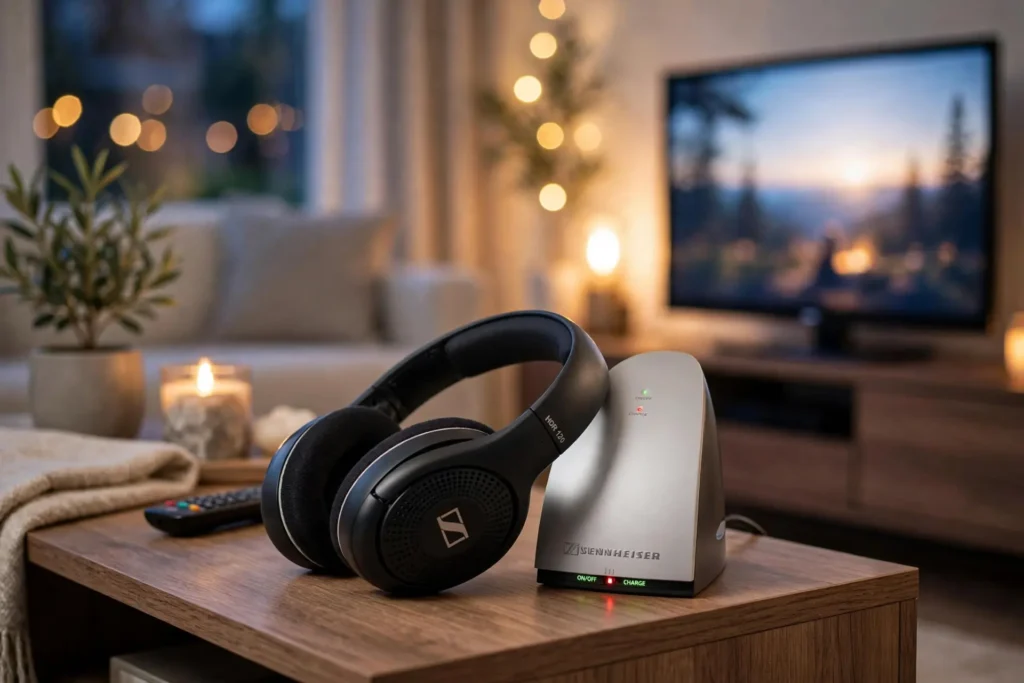
The sennheiser rs 120 ii is a long-running wireless headphone system built for one job: watching TV without cables. It’s an RF (radio frequency) system — not Bluetooth — made up of an HDR 120 on-ear headphone and a TR 120 transmitter base that doubles as a charging cradle. You plug the base into your TV’s analog audio output, sit back anywhere in the room, and tune in with a dial on the earcup.
This is a deliberately simple product in an era of app-controlled everything. There is no pairing, no firmware, no Bluetooth handshake to fail — and for a lot of TV watchers, that’s exactly the point. Our verdict: based on Sennheiser’s published specs and documentation plus what long-term owners report, the RS 120 II remains a strong value pick for TV-first wireless listening, with a few clear caveats you should know before buying.
SoundMavericks Review: Sennheiser RS 120 II
| Sound Quality | 8.2 |
| Comfort & Design | 7.6 |
| Wireless Range | 9.0 |
| Battery Life | 8.4 |
| Setup & Features | 8.8 |
| Value | 9.0 |

Sennheiser RS 120 II Specs
Here are the official specs, straight from Sennheiser’s documentation and the product listing:
| Wireless technology | RF analog (FM stereo), 3 selectable channels |
| Wireless range | Up to 100 m / 300 ft, through walls and ceilings |
| Frequency response | 22 – 19,500 Hz |
| Driver type | Dynamic |
| Sensitivity | 106 dB SPL |
| Impedance | 24 Ω |
| Total harmonic distortion | 0.7% |
| Ear coupling | Supra-aural (on-ear), open acoustic design |
| Battery | 2 × AAA NiMH rechargeable (included), ~20 hours |
| Charging | Transmitter base doubles as charging cradle |
| On-headphone controls | Volume, on/off, channel tuning |
| Inputs | Analog audio (RCA, 3.5 mm, 6.3 mm via adapters); not Bluetooth |
| Weight (headphones) | 230 g |
| In the box | HDR 120 headphones, TR 120 transmitter, power cable, 2 AAA NiMH batteries, RCA to 1/8″ adapter, 1/8″ to 1/4″ adapter, instructions |
| Warranty | 2-year international warranty |
Design and Comfort
The RS 120 II looks like what it is: a product with roots in the mid-2000s that has stayed in Sennheiser’s lineup because it works. The headphone is an open, on-ear (supra-aural) design with foam ear pads and a padded, adjustable headband. Build is mostly lightweight plastic — no memory foam, no leatherette, no folding hinges. It’s dated, not flimsy.
Comfort is a genuine strong point for the intended use. At 230 g with an open-back fit, the headphones stay cool and low-pressure across long TV sessions, which matters when the alternative is a hot closed-back clamping your head for three hours. The foam pads do soften with age, though replacements are generic and cheap. One honest limitation: the on-ear fit is adjustable but not generous — listeners with very large heads or glasses should check owners’ sizing notes first. If you’re comparing TV options, also see our best wireless headphones for TV watching guide.
Sound Quality
Sennheiser describes the RS 120 II’s sound as transparent and well-balanced with good bass reproduction, and the spec sheet backs a middle-of-the-road profile: 106 dB sensitivity, 24 Ω impedance, THD under 0.7%, and a 22–19,500 Hz frequency response. It’s tuned for dialogue clarity and TV/movie audio — voices sit forward, bass is present but not boomy, and the open design gives the soundstage a natural, airy feel.
What it is not: a hi-res music headphone. Analog RF transmission is a step behind modern Bluetooth codecs on raw fidelity, and owners consistently note a faint background hiss at high volume with quiet sources. For movies, sports, and late-night TV, that’s a non-issue for most people — but if pristine music reproduction is the goal, a dedicated wired Sennheiser like our reviewed Sennheiser HD 660S2 is the proper comparison point, not this.
Wireless Range: RF, Not Bluetooth
This is the RS 120 II’s killer feature and the reason it still sells. The transmitter uses FM stereo radio frequency on three selectable channels, giving a rated range of up to 100 meters (about 300 feet) — through walls and ceilings. Owners report walking between rooms and even outdoors within a house’s lot without dropouts, something no Bluetooth TV setup can match. RF doesn’t need pairing, doesn’t have Bluetooth’s ~10 m ceiling, and doesn’t care whether your TV supports the right codec.
The tradeoff is that RF is analog: pick the cleanest of the three channels with the tuning dial on the earcup if you hear interference, and keep the transmitter away from routers and microwaves. But for the core use case — one person watching TV wirelessly with freedom to move — RF is arguably the better technology than Bluetooth, and the RS 120 II is the cheapest way to get it from a name brand.
Battery Life and Charging
The system ships with two rechargeable AAA NiMH batteries installed in the earcups, rated for roughly 20 hours of continuous use. That’s comfortably more than a week of nightly TV for most households. The clever part is the charging design: the TR 120 transmitter base is also the charging cradle — when you’re done watching, you hang the headphones on the base and they recharge automatically. No separate charger, no battery juggling.
The transmitter also has an automatic on/off circuit: it powers up when it detects an audio signal and shuts off about five minutes after the source goes quiet. And since it runs on standard AAAs, you’re never stuck waiting for a charge — pop in regular alkalines as a backup and keep watching. That replaceable-battery design is one of the most practical things about the RS 120 II in an age of sealed-in lithium cells.
How to Connect the Sennheiser RS 120 II to Your TV
Setup is the part the RS 120 II nails, and it’s worth understanding because it decides whether this product fits your TV.
Step 1 — find an analog audio output on your TV. The transmitter connects to anything with an analog output: the headphone-out (3.5 mm) jack or the red/white RCA audio outputs. Plug in the transmitter’s attached audio cable, using the included RCA-to-1/8″ adapter if needed.
Step 2 — power the transmitter. Connect the transmitter’s power cable to a wall outlet and place the base within reach of your seat for charging — it’s wall-mountable too.
Step 3 — put the batteries in and tune in. Install the included AAA batteries, switch the headphones on, and turn the tuning dial on the earcup until the TV audio comes through clearly, choosing the cleanest of the three RF channels.
The big caveat: many modern TVs no longer have analog audio outputs — they’ve moved to optical, HDMI ARC, or Bluetooth-only. If yours is digital-only, the RS 120 II needs a separate digital-to-analog converter between the TV and the transmitter. Check the back of your TV before ordering; with a headphone jack or RCA out, setup takes minutes.
Sennheiser RS 120 II vs RS 175
The obvious upgrade question: should you get the RS 120 II or the bigger Sennheiser RS 175? The RS 175 is a closed-back surround-style RF system with a bass boost button and charging cradle — better isolation, more features, higher cost. Our read: the RS 175 is the pick for dedicated movie nights where immersion matters; the RS 120 II is the pick for everyday TV duty — lighter, simpler, open-back so you can still hear the doorbell, and easier on the wallet.
Pros and Cons
Pros
- Massive 300-ft RF range works through walls — far beyond Bluetooth
- No pairing, no apps, no firmware: setup in minutes
- Charging cradle doubles as the transmitter; auto on/off saves batteries
- ~20-hour battery on standard replaceable AAA NiMH cells
- Light, open-back on-ear fit stays cool during long TV sessions
- Extra HDR 120 headphones can join the same transmitter for a second listener
Cons
- Analog input only — modern TVs with digital-only outputs need a converter
- Not Bluetooth; won’t pair with phones or Bluetooth-only devices
- Dated plastic design; foam pads wear over time
- Faint analog hiss possible at high volume with quiet sources
- No microphone, no noise cancelling, no travel-friendly folding
FAQ: Sennheiser RS 120 II
Is the Sennheiser RS 120 II Bluetooth?
No. The RS 120 II uses analog RF (radio frequency) transmission, not Bluetooth. It cannot pair with phones, tablets, or Bluetooth-only devices — it connects via a wired analog link from your audio source to its transmitter base, then broadcasts wirelessly to the headphones.
How far is the Sennheiser RS 120 II range?
Sennheiser rates the range at up to 100 meters (about 300 feet) with line of sight, and because RF passes through walls and ceilings, owners commonly use it in adjacent rooms and outdoors around the house. Obstacles and interference can reduce the real-world distance; switching among the three RF channels helps.
How long does the RS 120 II battery last?
The two included rechargeable AAA NiMH batteries provide roughly 20 hours of operation. The headphones recharge automatically whenever they rest on the transmitter’s charging cradle, and the transmitter switches itself off a few minutes after the audio source stops, conserving battery life.
What comes in the box with the RS 120 II?
The HDR 120 headphone, the TR 120 transmitter (with attached audio cable), the transmitter power cable, two AAA NiMH rechargeable batteries, an RCA-to-1/8″ audio adapter, a 1/8″-to-1/4″ audio adapter, and the instruction manual.
Will the RS 120 II work with a modern smart TV?
It works with any TV that has an analog audio output (headphone jack or RCA outputs). Many newer smart TVs only offer optical or HDMI ARC audio-out — in that case you’ll need an inexpensive digital-to-analog converter between the TV and the transmitter. Check your TV’s outputs before buying.
Verdict: Should You Buy the Sennheiser RS 120 II?
The sennheiser rs 120 ii is a niche product that knows exactly what it is. If your problem is “I want to watch TV at my own volume without running cables across the room,” it solves that problem better than any Bluetooth alternative: enormous RF range, no pairing headaches, a charging dock you’ll actually use, and replaceable AAA batteries that keep it running for years. The open-back design keeps you comfortable for long sessions and aware of your surroundings.
Buy it if you have a TV with an analog audio output and want simple, long-range wireless listening. Skip it if your TV is digital-output only (unless you’re adding a converter), if you need Bluetooth for a phone or tablet, or if you want a music-first headphone — for that, look at Sennheiser’s wired lineup instead. Within its lane, though, the RS 120 II is the best-value wireless TV system Sennheiser makes.

I am the founder of Sound Mavericks, where I provide the polite truth about audio equipment. I started this site because consumer electronics reviews are often too technical. Instead of using a silent lab, I test headphones, earbuds, and Bluetooth speakers in the real world – like on a noisy subway or in a busy coffee shop.
To stay independent, I buy my own review units (mostly from the United States) rather than accepting free gifts from brands. Once I finish testing a product, I sell it locally to our community. My goal is to help you understand sound quality, active noise cancellation (ANC), and battery life without the marketing hype.