You have finally decided to upgrade your audio gear. You go online or walk into a store, ready to spend some real money on a quality pair of headphones. But then you hit a wall. You see two pairs from the same brand that look almost identical.
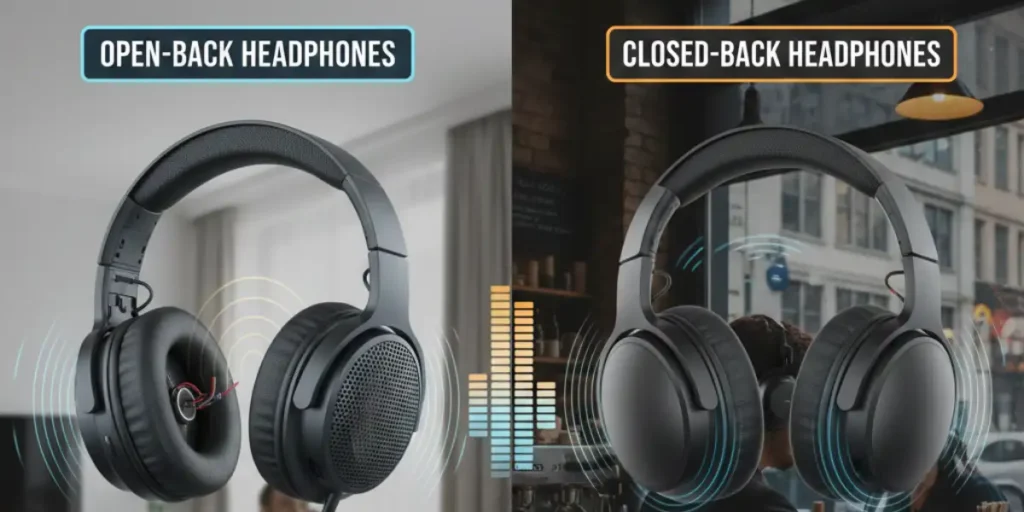
One has a solid outer shell. The other has a mesh grill with holes in it.
This isn’t just a fashion choice. The difference between open-back and closed-back headphones is the single most important factor in how your music will sound. It changes the bass, the clarity, and where you can actually use them.
If you buy the wrong type for your lifestyle, you will hate them, no matter how much they cost.
This guide will break down exactly how they differ, how they sound, and which one belongs on your head.
Open-Back vs. Closed-Back Headphones in Simple Terms
Before we get technical, let’s look at the basic physical design. It all comes down to the ear cup – the part that covers your ears.
- Closed-Back: The back of the ear cup is completely sealed. It is a solid piece of plastic, metal, or wood. Sound cannot get out, and noise cannot get in.
- Open-Back: The back of the ear cup is perforated. It has vents, grills, or mesh that allow air and sound to pass freely in and out of the headphone.
To understand the difference in sound, think about a room.
The Room Analogy
Imagine listening to a band playing inside a small, soundproof recording booth. This is Closed-Back. The sound is intense, focused, and intimate. You are locked in there with the music.
Now, imagine listening to that same band in a large concert hall with the windows open. This is Open-Back. The sound feels wide, airy, and natural. The music feels like it is around you, not just inside your head.
Here is a quick comparison to help you spot the differences:
| Feature | Closed-Back | Open-Back |
|---|---|---|
| Noise Isolation | High (Blocks outside noise) | Zero (You hear everything) |
| Sound Leakage | Low (People won’t hear your music) | High (Everyone hears your music) |
| Bass | Heavy, Punchy, Boomy | Tighter, Natural, Lighter |
| Soundstage | Narrow (Inside your head) | Wide (3D/Holographic) |
| Heat | Warm (Ears might sweat) | Cool (Ears can breathe) |
The Deep Dive: How Design Changes the Sound
Why does putting a few holes in a piece of plastic change the sound so much? It comes down to air pressure.
Closed-Back: The “In-Your-Head” Experience
When you put on closed-back headphones, you are creating a sealed chamber around your ear. When the speaker driver (the part that makes sound) pushes air, that air has nowhere to go. It is trapped inside the cup.
The Physics:
Because the air is trapped, the pressure builds up. This is great for bass frequencies. Low notes need to move a lot of air to feel powerful. The sealed design keeps that energy contained, resulting in a “thump” or “slam” that you can physically feel.
The Downside:
However, sound waves also bounce off the hard outer shell and reflect back into your ear. These tiny echoes can sometimes make the music sound “boxy” or cluttered. It can sound like the band is playing inside a closet. The separation between instruments is often less clear.
Open-Back: The Holographic Experience
Open-back headphones do the opposite. They allow air to flow through the ear cup. When the driver moves, the air pressure escapes out the back.
The Physics:
Because the air can escape, sound waves don’t bounce around inside the cup. There are no reflections to muddy up the sound. This creates what audiophiles call “Soundstage.”
Soundstage is the ability to hear exactly where an instrument is coming from. Instead of hearing the music “between your ears,” it sounds like the drummer is five feet in front of you, and the guitar is to your left. The music sounds 3D and holographic.
The Downside:
Because the air escapes, the bass pressure escapes too. Open-back headphones rarely have that earth-shaking, sub-bass rumble that closed-backs have. The bass is usually accurate and clean, but it won’t rattle your skull.
The Semi-Open Middle Ground
You might see some headphones labeled “Semi-Open.” Manufacturers try to sell this as the best of both worlds—some isolation with some soundstage.
In reality, treat these like open-back headphones. They still leak sound, and they still let noise in. They are rarely a true 50/50 split.
Scenario Tests: Where Do They Win?
Technology is only useful if it fits your life. Let’s look at three common scenarios to see which design wins.
1. The Commute & Office (The Isolation Test)
Winner: Closed-Back
This is an easy win. If you try to wear open-back headphones on a bus, train, or airplane, you will have a terrible time. Because there is zero isolation, the roar of the engine will mix with your music. To hear your song, you will have to turn the volume up to dangerous levels.
Worse, everyone around you will hear exactly what you are listening to. In a quiet office, your open-back headphones are essentially small speakers. Your coworkers will hate you.
If you are anywhere near other people or loud machinery, you must choose Closed-Back.
2. Critical Listening & Gaming (The Immersion Test)
Winner: Open-Back
If you are sitting in a quiet room at home, Open-Back is superior.
For Music:
If you listen to Jazz, Classical, Acoustic, or Classic Rock, open-backs allow you to hear the separation between instruments. You can hear the breath of the singer or the fingers sliding on a guitar string. It feels like a live performance.
For Gaming:
Serious gamers prefer open-back headsets. Why? Because of the soundstage. In a competitive shooter game, you need to know exactly where footsteps are coming from. Open-back headphones give you better directional accuracy. You can hear if an enemy is behind you and to the right, rather than just generally behind you.
3. Studio Use (Recording vs. Mixing)
Winner: It’s a Tie (Different jobs)
If you are a musician, you likely need both, but for different tasks.
- Recording (Tracking): You must use Closed-Back. If you wear open-backs while recording vocals, the sound from the headphones will leak out and get picked up by the microphone. This ruins the recording.
- Mixing: You should use Open-Back. When mixing a song, you want to hear the “truth.” Closed-back headphones can exaggerate bass, making you think the song has more low-end than it actually does. Open-backs give you a flat, honest representation of the track.
The Buying Guide: Who Should Buy What?
Still not sure? Let’s make it simple. Do not overthink it—just look at how you plan to use them.
Choose Closed-Back If…
- You listen in public: You take the bus, walk on busy streets, or work in an office.
- You are a Bass-Head: You love EDM, Hip-Hop, or Action Movies, and want to feel the impact.
- You need privacy: You don’t want your roommate or spouse to hear your playlist.
- You record vocals: You need to hear the backing track without it bleeding into the mic.
Choose Open-Back If…
- You have a “Music Sanctuary”: You have a quiet room where you can listen without interruption.
- You are a Gamer: You want a competitive advantage in FPS games.
- You prefer Detail over Power: You listen to complex music and want to hear every layer clearly.
- You hate sweaty ears: You plan to wear them for 4+ hours at a time and want airflow.
FAQ
Not necessarily. The need for an amplifier depends on “impedance” (ohms) and “sensitivity,” not the ear cup design. However, many high-end open-back headphones are designed for home use with big stereos, so they often benefit from the extra power of a dedicated amplifier.
No. First, everyone will hear your music. Second, the open vents allow moisture and sweat to get inside the driver mechanics easily. This can cause the internal parts to rust or fail over time. Stick to closed-back or earbuds for the gym.
No, but they are related. Almost all ANC headphones are closed-back by design. Closed-back provides “passive” isolation (like plugging your ears). ANC uses microphones and computer chips to actively erase outside noise. If you fly often, a standard closed-back headphone isn’t enough—you should get a specific ANC model.

I am the founder of Sound Mavericks, where I provide the polite truth about audio equipment. I started this site because consumer electronics reviews are often too technical. Instead of using a silent lab, I test headphones, earbuds, and Bluetooth speakers in the real world – like on a noisy subway or in a busy coffee shop.
To stay independent, I buy my own review units (mostly from the United States) rather than accepting free gifts from brands. Once I finish testing a product, I sell it locally to our community. My goal is to help you understand sound quality, active noise cancellation (ANC), and battery life without the marketing hype.