SoundMavericks’ picks are editorial analysis: we compared the current gaming-earbud lineup for latency, mic setup, comfort, battery and platform support against live Amazon US listings. Specs below are manufacturer and listing figures, not invented numbers. Last updated October 2026.
Gaming earbuds finally stopped being a compromise. A few years ago, “wireless earbuds for gaming” meant lip-sync lag, tinny mics and dying halfway through a raid. The current crop under the $100 tier ships with dedicated game modes that push latency down to 30–60ms, multi-mic arrays that keep squad chat intelligible, and battery life that survives a full evening session. This guide is about true wireless gaming earbuds — no cables, no boom mic headband, nothing to untangle from your controller.
Two quick notes before the picks. First, if you want absolute zero latency for competitive play, wired still wins — our best IEMs for gaming guide covers that side of the world, and this roundup deliberately picks a different product set. Second, if you’d rather have a full over-ear headset, see our noise cancelling headsets for gaming roundup. Now — the earbuds.
Our Top Picks at a Glance
★ OUR PICK: Razer Hammerhead True Wireless X
A 60ms gaming mode from the brand that defined gaming audio gear, with big 13mm drivers for explosive sound.
🎮 BEST FOR CONSOLE & VR: Soundcore VR P10
A 2.4GHz USB-C dongle plugs straight into PS5, Switch, Steam Deck or PC for near-wired latency, with Bluetooth running alongside for calls.
🔊 BEST ANC VALUE: EarFun Air 2 NC
Real adaptive noise cancelling, LDAC hi-res audio and a 55ms Game Mode in one pair — the best all-rounder here.
⚡ BEST FEATURE PACK: EarFun Air Pro 4
aptX Lossless, Snapdragon Sound, Bluetooth 5.4, 52-hour battery and Game Mode — flagship spec sheet, budget-tier price.
💰 BUDGET PICK: TOZO G1
45ms latency, dual gaming/music modes and a 36-hour total battery — the cheapest credible way into low-latency gaming audio.
Quick Comparison
| Earbuds | Game-mode latency | Mic setup | Total battery | Standout feature |
|---|---|---|---|---|
| Razer Hammerhead True Wireless X | 60ms | Built-in mics | 15 hrs | 13mm drivers, IPX4 |
| Soundcore VR P10 | ~30ms (dongle) | Built-in mics | 24 hrs | 2.4GHz dongle, dual connection |
| EarFun Air 2 NC | 55ms | 6 AI mics | 40 hrs | Adaptive ANC, LDAC |
| EarFun Air Pro 4 | 50ms | 6 AI mics | 52 hrs | aptX Lossless, BT 5.4 |
| TOZO G1 | 45ms | Built-in mic | 36 hrs | Gaming/music dual modes |
Latency and battery figures are manufacturer/listing figures in game mode where applicable; real-world numbers vary with codec and platform.
Best Overall: Razer Hammerhead True Wireless X

Key specs: 60ms low-latency gaming mode · 13mm dynamic drivers · Bluetooth 5.0 · IPX4 water resistance · 15-hour total battery with case · touch controls
Razer’s Hammerhead True Wireless X is the safe default recommendation in this tier, and our pick for best overall. It’s a purpose-built gaming bud: the dedicated gaming mode advertises 60ms latency, which is fast enough that footsteps and gunshots land on time in mobile shooters, and the 13mm drivers are among the largest you’ll find at this price — explosions and engine roars carry real weight. For a gamer’s first wireless pair, that’s the combination that matters most: speed you can feel and bass you can hear.
The compromises are honest ones. There’s no active noise cancelling here — the seal from the silicone tips does the isolation work — and 15 hours of total battery is merely adequate rather than class-leading. But the Hammerhead X knows exactly what it is: a gaming-first bud with no feature bloat. If your sessions are mostly mobile or PC gaming over Bluetooth, this is the pick we’d hand to a friend without caveats.
Pros: Purpose-built 60ms gaming mode; big 13mm drivers for punchy game audio; IPX4 sweat resistance; simple, gaming-first design.
Cons: No ANC; 15-hour total battery is mid-pack; Bluetooth 5.0 is a generation behind the field.
Best for Console & VR: Soundcore VR P10

Key specs: 2.4GHz USB-C dongle with ~30ms latency · dual connection (dongle + Bluetooth simultaneously) · 11mm drivers with BassUp · Bluetooth 5.2 · 24-hour total battery
The VR P10 solves the one problem every other bud on this list accepts: consoles. Bluetooth-only earbuds can’t talk to a PS5 or a Switch in docked mode without extra hardware. The VR P10 ships with a USB-C dongle that plugs straight into a PS5, PS4, Switch, Steam Deck or PC and delivers game audio at roughly 30ms — effectively wired speed. Meanwhile the buds stay paired to your phone over Bluetooth, so Discord calls or music keep flowing without pausing the game. For couch and handheld console gaming, that’s the killer feature in this tier.
Sound-wise, the 11mm drivers with Anker’s BassUp tuning lean cinematic rather than analytical — great for single-player immersion, slightly less ideal if you’re hunting footsteps in ranked shooters. And like the Razer, there’s no ANC here. But nothing else under the tier ceiling offers a true dual-connection dongle setup, and that alone earns the VR P10 its spot. It’s the pick for anyone whose gaming happens mostly on console or handheld.
Pros: USB-C dongle works with PS5, Switch, Steam Deck and PC; ~30ms latency over the dongle link; simultaneous Bluetooth for calls; big, cinematic sound.
Cons: No ANC; dongle is one more thing to carry (and lose); bass-leaning tuning isn’t ideal for competitive play.
Best ANC Value: EarFun Air 2 NC

Key specs: Dedicated Game Mode (~55ms per independent review coverage) · adaptive hybrid ANC · 6 AI mics for calls · 40-hour total battery · Bluetooth 5.3 · LDAC hi-res audio · multipoint connection · wireless charging
The Air 2 NC is the all-rounder’s answer to this category. Where the Razer and Soundcore are gaming specialists, this is a genuinely good everyday earbud that also games well: adaptive hybrid ANC for noisy rooms, LDAC support for hi-res music, multipoint so your laptop and phone stay connected at once, and a Game Mode that independent review coverage (arbmobi’s hands-on review) puts at about 55ms — competitive with anything here. Six AI mics keep squad chat and work calls alike in the clear, which is why it’s also the pick we’d recommend if your earbuds need to pull double duty outside gaming.
The tradeoff is focus: it doesn’t have the VR P10’s console dongle, and its game mode is software-side rather than a dedicated low-latency radio. But for the gamer who also commutes, works and listens to music, the Air 2 NC covers more ground than any other pick in this guide. It’s the best value in the tier because it refuses to be a one-trick pony.
Pros: Real ANC plus LDAC and multipoint — a complete everyday package; 40-hour battery; 6-mic array for clear calls; wireless charging.
Cons: No 2.4GHz dongle for consoles; game mode is software-based; ANC is good, not flagship-grade.
Best Feature Pack: EarFun Air Pro 4

Key specs: Game Mode (50ms listed latency) · adaptive hybrid ANC · 6 mics with AI call noise reduction · 52-hour total battery · Bluetooth 5.4 · LDAC + aptX Lossless + Snapdragon Sound · IPX5 · in-ear detection
The Air Pro 4 reads like a flagship spec sheet that wandered into the wrong price bracket. Bluetooth 5.4, Snapdragon Sound, aptX Lossless for audiophile-grade wireless audio, a 52-hour total battery that borders on absurd, and a Game Mode the listing pegs at 50ms. For the gamer who cares about codecs and future-proofing — multipoint, LE Audio readiness, in-ear detection — this is the most technologically complete bud in the tier.
So why isn’t it the overall pick? Specialization beats specification in gaming. The Hammerhead X’s gaming-tuned sound and the VR P10’s console dongle solve gamer-specific problems more directly than a longer codec list does. But if your earbuds live in your ears all day — music, calls, video, and gaming — the Air Pro 4’s battery and feature depth make it the smartest long-term buy here. Note that Game Mode usually forces a lower-bitrate codec, so toggle it off for music to enjoy the aptX Lossless goodness.
Pros: 52-hour battery; flagship codec support (LDAC, aptX Lossless); Bluetooth 5.4; IPX5 water resistance; full app customization.
Cons: Game Mode trades audio quality for speed like everything else; sound tuning leans musical rather than gaming-tuned; no console dongle.
Budget Pick: TOZO G1
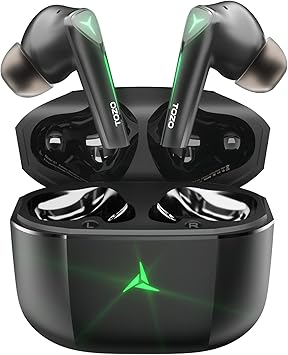
Key specs: 45ms ultra low-latency gaming mode · dual gaming/music sound modes · Bluetooth 5.3 · 36-hour total battery (6 hrs buds + 30 hrs case) · breathing LED light · built-in mic
The TOZO G1 is proof that the entry price for credible gaming audio keeps falling. A 45ms gaming mode is genuinely competitive with buds costing multiples more, the dual sound modes (gaming for speed and punch, music for deep bass) are a thoughtful touch most budget buds skip, and 36 hours of total battery means the case is a monthly charger, not a weekly one. The breathing LED on the case is pure gamer aesthetic — love it or hate it, you can’t miss it.
Set expectations honestly: the mic is functional for casual chat, not for streaming; there’s no ANC; and the sound is fun rather than refined. But as a first pair of gaming earbuds, a travel backup, or a gift for a younger gamer, the G1 delivers the core gaming feature — low latency — at a price where everything else is just bonus. That’s exactly what a budget pick should do.
Pros: 45ms latency rivals far pricier buds; gaming/music dual modes; 36-hour total battery; unmistakable gamer styling.
Cons: Basic mic; no ANC; sound quality is fun, not refined.
Honorable Mentions
ASUS ROG Cetra True Wireless SpeedNova. The successor to the classic ROG Cetra gaming buds is excellent — 2.4GHz + Bluetooth dual mode, bone-conduction mics, adaptive ANC — but it sits above this roundup’s price ceiling, so it didn’t make the cut. If your budget stretches, it’s the premium step-up.
JBL Quantum TWS. JBL’s gaming earbuds with QuantumSURROUND are a strong pick on paper, but at the time of writing only renewed listings were available on Amazon US — we don’t recommend renewed-only listings in our roundups, so it’s benched until a new listing stabilizes.
Wired IEMs. If latency is everything to you — competitive shooters, rhythm games, tournament play — skip wireless entirely and read our best IEMs for gaming guide. A cable is still the only true zero-latency connection.
How to Choose Gaming Earbuds Under $100
Latency first. This is the spec that defines the category. Standard Bluetooth runs 150–250ms of delay — you’ll feel it as lip-sync lag and late footsteps. A dedicated game mode cuts that to roughly 30–60ms, and a 2.4GHz dongle (like the VR P10’s) gets you to near-wired speeds. If a bud doesn’t advertise a game mode or low-latency figure, assume it’s not built for gaming.
Mics matter more than you think. Every multiplayer session is a voice call. Four to six mics with noise-reduction processing (the EarFuns’ AI arrays) keep callouts clear; a single basic mic (the TOZO G1) is fine for casual lobbies but not for leading a raid. If calls are half your use case, our earbuds for phone calls roundup digs deeper on mic quality.
Comfort for long sessions. Gaming sessions run longer than commutes. Lightweight buds with multiple tip sizes and a secure seal prevent the ear fatigue that ends a night early. All five picks here ship with multiple tip sizes — try them all; the right seal also improves bass and isolation.
Battery reality. “Total battery” includes the case, and game mode drains buds faster than music mode. For evening-length sessions, anything at 24 hours total or above gives you a comfortable buffer; the EarFun picks’ 40–52 hours are genuinely forget-the-charger territory.
Codecs and platforms. Game mode typically forces a lower-bitrate codec to hit its latency numbers — that’s the tradeoff, and it’s why our Bluetooth codecs explainer is worth a skim. Also confirm your platform: everything here works over Bluetooth with phones and PCs, but for PS5 or docked Switch you want a 2.4GHz dongle bud like the VR P10.
Frequently Asked Questions
Do wireless earbuds have too much latency for gaming?
Not anymore — at least not for casual and mobile play. Standard Bluetooth runs 150–250ms, which is noticeable. But the gaming earbuds in this guide cut that to 30–60ms in their dedicated game modes, close enough that most players stop noticing. For competitive ranked play where every millisecond matters, wired IEMs are still the safer pick — see our best IEMs for gaming guide for zero-latency options.
Can I use gaming earbuds with PS5, Nintendo Switch, and PC?
Yes, but check the connection type. Most gaming earbuds work with anything over Bluetooth, including phones, Switch (docked or handheld) and PCs. Some, like the Soundcore VR P10, add a USB-C 2.4GHz dongle that plugs straight into PS5, Switch, Steam Deck or PC for near-wired latency plus simultaneous phone calls over Bluetooth — handy when you want Discord and game audio at once.
Are gaming earbud mics good enough for voice chat?
For casual squad chat, yes. The picks here carry multiple mics with noise-reduction processing, which keeps callouts clear in a normal room. They won’t match a dedicated boom-mic headset in a noisy house, though. If crystal-clear calls matter most — for streaming or work calls too — see our best noise cancelling earbuds for phone calls roundup.
What does Game Mode actually do on earbuds?
Game Mode trades audio fidelity for speed. It shortens the Bluetooth buffer so sound reaches your ears faster, typically dropping latency from 150–250ms down to 30–60ms. The tradeoff is usually lower sound quality (game mode often forces a lower-quality codec) and slightly higher battery drain, so toggle it off for music.
Should I get wired IEMs or wireless gaming earbuds?
Pick wired IEMs if you play competitive shooters or rhythm games where latency is everything — our best IEMs for gaming guide covers those. Pick wireless gaming earbuds if you value freedom of movement, play on the couch, commute with your Switch, or game on your phone. Many gamers end up owning both: wireless for daily play, wired for tournaments.

I am the founder of Sound Mavericks, where I provide the polite truth about audio equipment. I started this site because consumer electronics reviews are often too technical. Instead of using a silent lab, I test headphones, earbuds, and Bluetooth speakers in the real world – like on a noisy subway or in a busy coffee shop.
To stay independent, I buy my own review units (mostly from the United States) rather than accepting free gifts from brands. Once I finish testing a product, I sell it locally to our community. My goal is to help you understand sound quality, active noise cancellation (ANC), and battery life without the marketing hype.