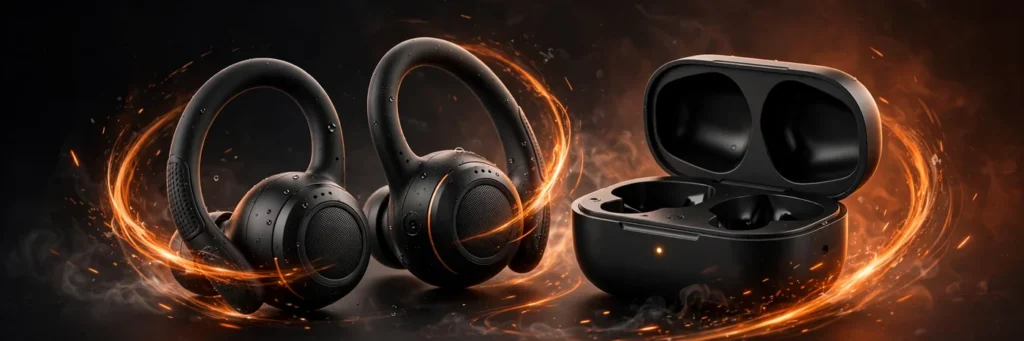
The Beats Powerbeats Pro 2 are the most complete workout earbuds Beats has ever made — and our verdict is simple: if training is the center of your audio life, these are the best sport earbuds you can buy in 2026. They combine secure nickel-titanium earhook fit with Apple’s H2 chip, genuinely strong ANC, class-leading battery life, and the headline feature — a built-in optical heart rate monitor that turns your earbuds into a fitness tracker. Caveats: Android users get a thinner feature set, the ANC isn’t the absolute strongest on the market, and the bass-forward tuning won’t win over purists. But for runners, lifters, and cyclists, the total package is unmatched.
| Sound Quality | 8.4 |
| Noise Cancelling | 8.2 |
| Secure Fit & Comfort | 9.5 |
| Battery Life | 9.6 |
| Fitness Features | 9.0 |
| Call Quality | 8.0 |
| Value | 8.6 |
Powerbeats Pro 2 Specs at a Glance
| Spec | Detail |
|---|---|
| Chip | Apple H2 |
| Drivers | 9.5mm dual-layer dynamic |
| Noise control | Active Noise Cancellation + Transparency Mode |
| Heart rate monitor | Optical PPG sensor in each earbud |
| Battery (buds) | Up to 10 hrs (ANC off) / 8 hrs (ANC on) |
| Battery (with case) | Up to 45 hrs (ANC off) / 36 hrs (ANC on) |
| Fast charging | 5-minute charge ≈ 90 minutes playback |
| Charging case | USB-C + Qi wireless (33% smaller than original) |
| Water resistance | IPX4 (sweat & splash) |
| Bluetooth | 5.3 (Class 1) |
| Weight | ≈8.7g per earbud; 20% lighter than original |
| Fit | Nickel-titanium earhooks + 5 ear tip sizes |
| Sound features | Adaptive EQ, Personalized Spatial Audio w/ head tracking |
| Extras | Hands-free Siri, Find My, Audio Sharing |
| Colors | Jet Black, Quick Sand, Hyper Purple, Electric Orange |
What the Powerbeats Pro 2 Get Right for Athletes
Released in February 2025, the Powerbeats Pro 2 marked a genuine first: the first Apple or Beats product to ship with built-in heart rate monitoring. The H2 chip — the same silicon as the AirPods Pro 2 — drives ANC, Transparency Mode, Adaptive EQ, and Personalized Spatial Audio, while Beats layered fitness hardware no AirPods model has: a biometric sensor, sport earhooks, and workout-grade battery life. These are purpose-built tools, not generalist earbuds — everything about them is optimized for training sessions.
Heart Rate Monitoring: The Feature That Defines Them

The heart rate system is a miniaturized optical sensor built on photoplethysmography (PPG): a green LED in each earbud pulses against the ear canal skin, a photodiode measures the reflected light, and an accelerometer filters out motion artifacts. The ear canal’s proximity to the temporal artery gives it a cleaner signal than wrist sensors during steady-state exercise.
Our honest assessment: during steady-state work — consistent-pace runs, cycling, moderate gym cardio — the sensor delivers acceptably accurate real-time data, feeding apps like Nike Run Club and Peloton on iOS and Android. During HIIT, boxing, or anything with heavy head movement, readings get inconsistent — Tom’s Guide and DC Rainmaker documented this, and RTINGS characterized the sensor as handy but not a substitute for a dedicated device. Treat it as a fitness supplement built into your earbuds, not a replacement for a chest strap if you need precision data during variable-intensity sessions.
One platform caveat: on iOS, heart rate sessions start and stop automatically; on Android, monitoring requires a manual double tap-and-hold on either earbud. Android users get the same hardware, but the experience is less seamless.
Design, Fit & Durability
The nickel-titanium alloy earhooks are the physical foundation of the Powerbeats Pro 2 experience: the shape-memory material flexes under force and snaps back to its preset shape, and the hook geometry was refined across more than 1,500 hours of athlete testing. Each earbud weighs roughly 8.7 grams — about 20% lighter than the original — with five silicone ear tip sizes in the box. The result locks in during sprints, HIIT, and heavy lifting; in our judgment, no in-ear design stays planted during explosive movement like a well-executed earhook.
The charging case is 33% smaller than the original’s bulky case and charges over USB-C and Qi wireless. IPX4 withstands sweat and splashes from any direction — every indoor workout and most light-rain runs are covered. Competing fitness earbuds with IPX5 or IPX7 ratings handle worse weather; our IP ratings guide explains the differences. Earhooks suit some ear shapes better than others, so if you have smaller ears, see our best earbuds for small ears guide.
Sound Quality
The 9.5mm dual-layer drivers deliver the signature Beats tuning: dynamic, energetic, and bass-forward. Multiple reviewers described the low end as dynamic and pulsing, and the tuning clearly leans toward excitement rather than neutrality. For workout motivation — the actual use case — that’s a strength: punchy bass and forward mids keep energy high at tempo, with Adaptive EQ adjusting the tuning to your ear fit automatically. Purists should know there’s no custom EQ (Android users get no equalizer in the Beats app at all), and on Apple devices Personalized Spatial Audio with dynamic head tracking adds an immersive dimension for movies.
Noise Cancelling & Transparency
The H2 chip’s feedforward-and-feedback ANC pipeline — the same architecture that made the AirPods Pro 2 an ANC benchmark — delivers strong, genuinely useful noise reduction: plenty for gym chatter, treadmill noise, and transit rumble. Six microphones feed the system, and our analysis agrees with the reviewer consensus: for athletic contexts this is more than enough, since a secure fit does as much work as the electronics.
Full honesty requires the competitive context: measured purely for attenuation, the Sony WF-1000XM5 and Bose flagship earbuds edge ahead. If ANC depth is your primary criterion — for flights and commuting — dedicated flagships win. For workouts, the gap is narrow and earhook fit matters far more. Transparency Mode was praised as among the best in the form factor by multiple reviewers — and for runners, good transparency arguably matters more than maximum ANC. Our ANC vs. passive isolation explainer covers why fit does so much of the heavy lifting.
Battery Life & Charging
This is where the Powerbeats Pro 2 lead their category: up to 10 hours per charge with ANC off (8 hours with ANC on), and up to 45 hours total with the case — nearly double the per-charge time of the AirPods Pro 2. That’s a full marathon, a long ride, or a week of gym sessions without a charger. A five-minute Fast Fuel top-up returns roughly 90 minutes of playback for athletes who forgot to charge overnight, and USB-C plus Qi wireless charging means the case tops up on whatever cable or pad you own.
Controls & Connectivity: The iOS/Android Divide
Each earbud carries an on-ear button plus a physical volume rocker — rare on true wireless earbuds and genuinely useful mid-workout with sweaty hands or gloves. Hands-free Siri, Find My, Audio Sharing, and automatic switching between Apple devices all work on iOS. Android users get the full hardware spec — H2 processing, Bluetooth 5.3, ANC, transparency, heart rate — but lose the Apple-exclusive software layer: no Personalized Spatial Audio with head tracking, no automatic device switching, and no EQ in the Beats app. There’s also no cross-platform multipoint, which frustrates anyone juggling a laptop and phone across ecosystems — our Bluetooth multipoint guide explains what’s missing.
How They Stack Up Against Alternatives
The natural comparison is the AirPods Pro 2, which share the H2 chip, ANC, and Transparency Mode. The Powerbeats add the heart rate sensor, far longer per-charge battery life, and the sport earhook fit; the AirPods counter with a smaller, more pocketable case and a hook-free fit some prefer for office and casual use. Athletes should pick the Powerbeats; casual all-rounders may prefer the AirPods — our AirPods 5 vs AirPods Pro 3 comparison covers Apple’s current lineup. For dedicated workout buying advice, see our best noise-cancelling headphones for the gym & workouts roundup, and our Beats Studio3 Wireless review covers the brand’s classic over-ear ANC headphone.
Who Should Buy — and Who Should Skip
Buy the Powerbeats Pro 2 if: you train several times a week and want one device for music plus heart rate data; you’re an iPhone user who wants full ecosystem integration; you do steady-state cardio where the PPG sensor shines; you’ve struggled with earbuds falling out; or battery anxiety is real for you.
Consider alternatives if: you’re an Android user who’d miss multipoint and deep software integration; you want the absolute deepest ANC for commuting and flights; you prefer neutral tuning with a real EQ; or you only work out occasionally and would pay for workout features you rarely use.
Frequently Asked Questions
How accurate is the Powerbeats Pro 2 heart rate monitor?
During steady-state exercise — consistent-pace running, cycling, moderate gym cardio — the optical PPG sensor delivers readings reviewers found acceptably accurate versus dedicated monitors. During HIIT or activities with heavy head movement, motion artifacts make readings inconsistent. It’s a meaningful fitness supplement, not a replacement for a chest strap if you need precision data in variable-intensity sessions.
Do the Powerbeats Pro 2 work well with Android phones?
Yes for hardware, with software caveats. Android users get the full spec — H2 processing, Bluetooth 5.3, ANC, Transparency Mode, IPX4 resistance, and heart rate monitoring — through the Beats app. What’s missing: Personalized Spatial Audio with head tracking, automatic device switching, automatic heart rate session start/stop (Android needs a manual double tap-and-hold), and any equalizer. Stronger on iPhone, but Android athletes still get a very capable product.
Can you swim with the Powerbeats Pro 2?
No. IPX4 covers sweat and splashes from any direction, but the earbuds are not rated for submersion. They’re fine for any gym workout and light-rain runs; swimmers and heavy-rain trail runners should look for earbuds rated IPX7 or higher.
Powerbeats Pro 2 vs. AirPods Pro 2 — which should I buy?
Both run Apple’s H2 chip with ANC, Transparency Mode, Adaptive EQ, and Spatial Audio. The Powerbeats Pro 2 add a heart rate monitor the AirPods Pro 2 lack, nearly double the per-charge battery life, and the secure earhook fit athletes want. The AirPods Pro 2 have a smaller, more pocketable case and a hook-free fit some prefer for casual and office use. For training, pick the Powerbeats; for everyday all-round listening, the AirPods hold their own.
How many ear tip sizes come with the Powerbeats Pro 2?
Five silicone ear tip sizes are included in the box, alongside the adjustable nickel-titanium secure-fit earhooks. If standard in-ear buds tend to fall out or hurt your ears, the hook design is worth trying — but check our best earbuds for small ears guide if earhooks aren’t for you.
The SoundMavericks Verdict
The Beats Powerbeats Pro 2 earn their 8.7/10 by doing one thing better than any rival: being the complete workout earbud. The earhooks solve the number-one workout earbud problem, the heart rate monitor is a genuinely useful addition for steady-state training, battery life is best in class, and the H2 chip delivers strong ANC with excellent transparency for outdoor safety. The caveats are real — thinner software on Android, ANC that trails dedicated flagships, bass-forward tuning with no custom EQ — but none undermine the core mission. If your training comes first, these are our pick.

I am the founder of Sound Mavericks, where I provide the polite truth about audio equipment. I started this site because consumer electronics reviews are often too technical. Instead of using a silent lab, I test headphones, earbuds, and Bluetooth speakers in the real world – like on a noisy subway or in a busy coffee shop.
To stay independent, I buy my own review units (mostly from the United States) rather than accepting free gifts from brands. Once I finish testing a product, I sell it locally to our community. My goal is to help you understand sound quality, active noise cancellation (ANC), and battery life without the marketing hype.