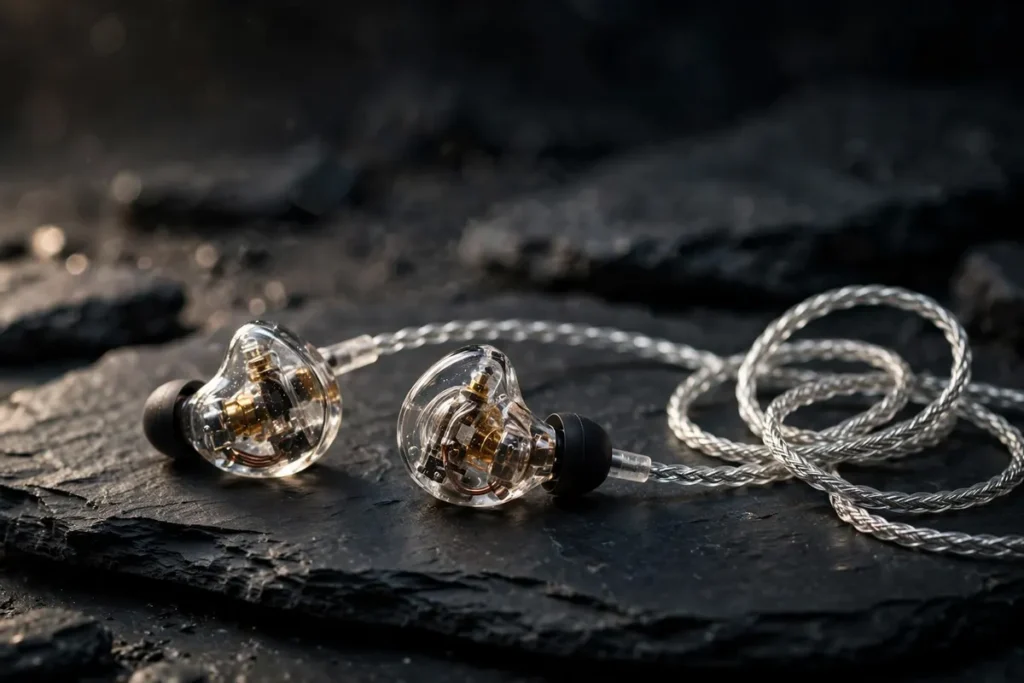
The KZ ACE10 is a gaming IEM sold as a system: a 1DD+4BA hybrid earphone plus a pocket DSP sound card with a color screen, eight sound modes and dual microphones. The modes include profiles named for Counter-Strike, VALORANT and Delta Force, and the card doubles as the DAC and amplifier over USB-C or USB-A. It is on sale now at KZ’s official store, and a US Amazon listing is live.
This is a launch review, built from KZ’s published specifications, its store materials and the verified listing. We have not listened to the ACE10, and nothing here pretends otherwise. What follows is paper analysis: the hardware, how the gaming system is put together, and who should buy or wait. This page updates as independent measurements and reviews appear.

KZ ACE10 On sale now
What it is: a hybrid gaming IEM whose bundled DSP sound card carries per-game sound modes, PC EQ software and dual ECM microphones with AI noise reduction.
Watch out: the game modes and mic live in the bundled sound card, so the full system only works through it. KZ does not publish the dynamic driver’s size or the balanced armature models.
1DD + 4BA hybrid · DSP sound card with color screen · 8 sound modes · Dual ECM mic · 0.78mm 2-pin
KZ ACE10 quick facts
| Drivers | 1 dynamic driver + 4 balanced armatures per side, PCB crossover |
| Launch price | $89.99 |
| Status | On sale now at KZ’s official store and on Amazon US |
| Where to buy | Amazon US and the KZ official store |
| Amazon US | Listed, ASIN B0HJGZ5S7K (verified November 20, 2026) |
| In the box | Earphones, color-screen DSP gaming sound card, 3.5mm silver-plated cable, USB-C to USB-C and USB-C to USB-A adapter cables, three pairs of silicone tips |
What the ACE10 is
Most gaming IEMs are music IEMs with a mic cable and a marketing pass. The ACE10 is built the other way: the earphone is one half of the product, and the bundled sound card is the other. The card is a small DAC and DSP unit with a color screen and physical buttons. It switches between eight modes: a general Game mode, dedicated profiles for Counter-Strike, VALORANT and Delta Force, then Music, Bass and Hi-Fi modes for listening, and a Custom mode that pairs with KZ’s PC software for building your own EQ curve. Connected over USB, the software also controls headphone and microphone volume and the AI noise-reduction switch in real time.
The earphone itself is a hybrid: one dynamic driver for the low end and four custom balanced armatures above it, divided by a PCB crossover. KZ does not publish the dynamic driver’s diameter or the armature model numbers, so we do not guess at them. The shell is shaped for an over-ear cable route, the connector is a gold-plated 0.78mm 2-pin, and the stock cable is silver-plated with a 3.5mm plug, so the earphone also works on its own into a controller or phone. How it compares with the rest of KZ’s range is a running theme in our Chi-Fi coverage, including the recent KZ ZAX review and KZ ZSX review.
Tuning and the gaming brief
KZ publishes an acoustic curve for the ACE10, measured in its own laboratory, and describes the target in positional terms: lift the mid-high region where footsteps, reloads and ability cues sit, so direction and distance are easier to read. The company also says the tuning was done with input from ScreaM, the Counter-Strike player. Both points are KZ’s claims, presented as such; the curve is a manufacturer measurement, not an independent one.
The microphone side is part of the same brief. Two ECM microphones sit in the system with an AI noise-reduction algorithm behind them, a one-touch mute, and controls on the sound card itself. For team chat that arrangement is a step beyond the in-line mic on a standard cable, provided the noise reduction behaves as described. Players comparing pure tuning against DSP features should also read our best IEMs for gaming guide, where the picks win on tuning alone.
KZ ACE10 specifications
| Product | KZ ACE10 Check Price |
| Drivers | 1 dynamic driver + 4 balanced armatures per side; PCB crossover |
| Impedance | 24 ohms |
| Sensitivity | 105 ± 3 dB/mW at 1kHz |
| Frequency response | 20Hz to 40kHz (KZ figures) |
| Connector | 0.78mm 2-pin, gold-plated, detachable |
| Cable | Silver-plated, 120 ± 5cm, 3.5mm plug |
| Sound card | DSP gaming sound card (DAC/DSP) with color screen and physical controls |
| Sound modes | Game, Counter-Strike, VALORANT, Delta Force, Music, Bass, Hi-Fi, Custom |
| Microphone | Dual ECM microphones with AI noise reduction; one-touch mute |
| Connections in the box | 3.5mm cable, USB-C to USB-C adapter cable, USB-C to USB-A adapter cable |
| Ear tips | Three pairs of silicone tips (S/M/L) |
| Launch price | $89.99 |
Early coverage
The first hands-on review is already out: MobileAudiophile tested the ACE10 and, as its title puts it, judged it for music as much as for gaming, working from the full retail package including the sound card. That is the right test for this product, because the earphone has to hold up once the game closes. KZ’s own launch materials lean on the ScreaM endorsement and the per-game modes. Independent measurements of the earphone and the sound card’s modes are still to come, and this page will carry them.
Should you buy, or wait?
The buy case is a PC or console player who wants the whole chain in one box: positional tuning, per-game profiles you can switch on the card, a real microphone setup and cables for 3.5mm, USB-C and USB-A without extra adapters. Nothing else in our gaming coverage bundles a DSP card at this level, and the earphone’s hybrid configuration is a proven recipe on paper.
The wait case is proof. The modes are KZ’s processing, and how much they help beyond the base tuning is a listening question that one early review cannot settle. If you play on a single platform and already own a good mic, a tuning-first pick from the alternatives below may serve you better. And if the sound card stays in a drawer, you have paid for half a product.
Also consider
Three covered gaming IEMs that win on tuning, without a DSP card in the box.

The same 1DD + 4BA hybrid recipe, tuned for all-round listening: strong imaging for games and a music tuning that keeps it in your ears between sessions. No microphone in the box, though.

Our top gaming pick: dual dynamic drivers with the sharpest imaging in its class and a mic cable in the box. No DSP card and no game modes, just tuning that works.

The budget benchmark: one clean dynamic driver, a metal shell and a detachable cable. No mic on the standard version and no DSP, but the clarity per dollar is hard to beat.
FAQ
Is the KZ ACE10 on Amazon?
Yes, under ASIN B0HJGZ5S7K, verified on November 20, 2026. The listing title reads “ACE10 Gaming IEM for FPS with Mic, 1DD+4BA in-Ear Monitor”. KZ’s official store carries it as well.
How much does the KZ ACE10 cost?
The launch price is in the quick facts box at the top of this page, and it is the same at KZ’s official store and on Amazon US as of writing.
Where can I buy the KZ ACE10?
Amazon US, under ASIN B0HJGZ5S7K, and the KZ official store. The button at the top goes to the Amazon listing.
What drivers does the KZ ACE10 use?
One dynamic driver and four balanced armatures per side, split by a PCB crossover. KZ does not publish the dynamic driver’s size or the armature models. Early teaser graphics mentioned a different count; the shipping specification on KZ’s store and the retail package is 1DD + 4BA.
What does the ACE10 sound card do?
It is a DAC and DSP unit with a color screen. It carries eight sound modes (Game, Counter-Strike, VALORANT, Delta Force, Music, Bass, Hi-Fi and Custom), the dual ECM microphones with AI noise reduction, and, over USB, KZ’s PC software for custom EQ curves and volume control.
Does the KZ ACE10 work with consoles and phones?
Yes. The box includes a 3.5mm cable plus USB-C to USB-C and USB-C to USB-A adapter cables, covering PC, PlayStation, Xbox controllers, Switch and phones. The full mode and microphone system runs through the bundled sound card.

I am the founder of Sound Mavericks, where I provide the polite truth about audio equipment. I started this site because consumer electronics reviews are often too technical. Instead of using a silent lab, I test headphones, earbuds, and Bluetooth speakers in the real world – like on a noisy subway or in a busy coffee shop.
To stay independent, I buy my own review units (mostly from the United States) rather than accepting free gifts from brands. Once I finish testing a product, I sell it locally to our community. My goal is to help you understand sound quality, active noise cancellation (ANC), and battery life without the marketing hype.