
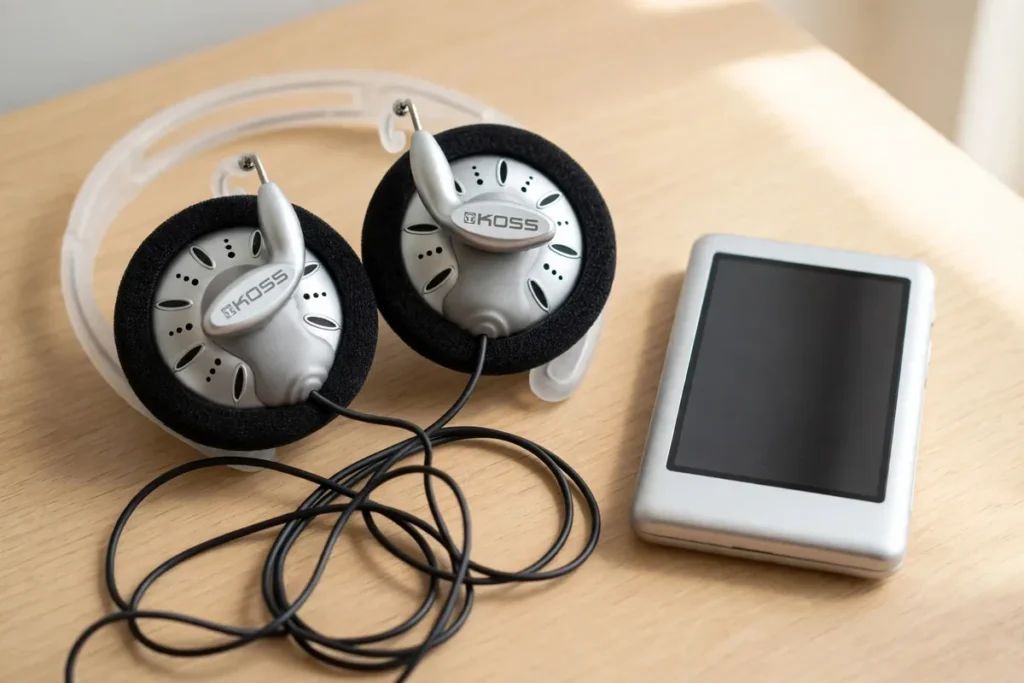
This koss ksc75 review covers the featherweight clip-on that has been the budget listener’s open secret for two decades: a titanium-coated driver on a bendable ear clip, no headband, no battery, no app and no microphone. Our verdict is 5.8 overall, and the bars explain a split personality. Value scores 9.6 and Comfort 8.4, Sound holds a respectable 7.8, and then the open design collects its tax: an ANC bar of 1.0 for a headphone that isolates nothing on purpose. Read the card as a whole and the KSC75 is exactly what its fans claim, a superb music buy with deliberate, obvious limits.

Koss KSC75 5.8/10
Why you: you want open, natural sound with nothing on your head. The clips weigh almost nothing, your ears stay cool, and the midrange and staging embarrass headphones costing several times more, which is why Value scores 9.6.
Trade-off: there is essentially no isolation and sound leaks both ways, the bass is lean below the mid-bass, and the thin fixed cable is the known weak point. The clips can also fight with glasses frames.
Titanium-coated dynamic driver · Open-back ear-clip design · 60 ohms · Fixed cable · No headband
Sound quality
Sound scores 7.8, and the midrange earns most of it. Vocals sit full and natural, acoustic guitars carry real body in the upper bass, and instrument separation stays clean because the lean low end never crowds the middle of the mix. Audiowords’ reviewer consensus lands in the same place: the midrange is the tuning’s strength, with a forward upper-mid region, and imaging and separation are good for the money. That consensus also agrees on the boundary. Deep bass rolls off steeply on every measurement rig, so sub-bass is simply missing rather than merely quiet.
Treble is where listeners argue. Crinacle classifies the KSC75 as a bass-rolled V-shape, and the measurement behind that label shows a lift through the upper mids with a peak in the 4 to 5 kHz region. Fans hear liveliness and air. Sensitive ears hear an edge that turns harsh on bright recordings. Both camps are describing the same shape, and which one you join depends on your ears and your library. Our best headphones under the entry tier guide keeps the KSC75 as the open-sound pick for exactly this reason: nothing sealed at the level stages music this wide.
What it does to different music
Jazz, folk, classical and vocal pop flatter it. Strings have air around them, small ensembles separate into players rather than a blend, and the open stage makes live recordings feel live. Electronic music and hip-hop expose the missing bottom octave at once, and no EQ fully restores it, because the driver and the open housing give the boost nothing to push against. Rock sits in between: guitars and voices shine, kick drums lose their thump.
Isolation, leakage and calls
The ANC bar reads 1.0, the lowest score on any card in this batch, and it is an honest number. The KSC75 has no cancelling electronics and its open housing blocks nothing passively either. You hear the room, and the room hears you. In a library or a quiet office carriage that leakage is antisocial. On a walk, at a desk at home or in a warm room where awareness is safety, the openness is the feature. Our best clip-on earbuds coverage makes the same trade explicit for the wireless side of the family.
Calls score 3.0 because there is no microphone at all. The cable is a plain stereo lead. Paired with a desk mic or a laptop’s built-in array the KSC75 works fine as the listening half of a call setup, and its open design means you hear your own voice naturally rather than through a sidetone circuit. As a standalone call device it simply is not one. Battery scores the neutral 5.0 given to wired models, since there is nothing to charge.
Comfort, clips and the glasses question
Comfort scores 8.4. There is no headband, no clamp and almost no weight, so the usual long-session complaints never start: no crown pressure, no sweaty sealed ear, no jaw ache. Head-Fi’s reviewer summary calls it extremely comfortable and almost weightless, and that matches the design. The clips are bendable wire under a plastic coating, and the first fit is a fitting, not a wearing. Bend them once to your ears and they hold that shape for months.
The feed caution names the real friction: the clips can fight with glasses frames, because both want the same strip of ear. Most glasses wearers solve it by seating the clip first and resting the frame arm over it, and some never get a truce and move the drivers onto a cheap headband instead, a swap this driver family was practically designed for. The build is plain plastic and the cable is thin and fixed, with the joint at the driver the known failure point. Koss’s lifetime warranty stands behind it, which is why the failure reads as an errand rather than a loss.
One product-specific trait explains half the KSC75’s legend: it is a modding platform disguised as a finished product. The drivers unclip in seconds and snap onto the headband of its sibling, the Koss Porta Pro, or onto cheap aftermarket bands, and thicker pads press the driver closer to the ear, which adds bass and softens the treble peak in one move. Measurements of the common headband swap show exactly that shift. A stock pair is bright-leaning and lean. The pair half the internet praises is often a lightly modified one, and the modification costs less than the headphone.
Value and who should buy it
Value scores 9.6, the highest bar in this batch, because the sound-per-money maths has no rival here. Natural mids, real staging and honest detail from a clip of plastic and wire is a trick no sealed budget headphone pulls off. It also doubles as the warm-weather and exercise pick in our best headphones for iPod and Walkman coverage, where its light, open fit suits portable players and long walks. The 5.8 overall is the price of the open design scored honestly: a headphone this exposed cannot win the isolation or calls bars, and was never built to.
Koss KSC75 specs
| Spec | Koss KSC75 |
|---|---|
| Driver | Titanium-coated dynamic driver |
| Form | Open-back ear-clip, no headband |
| Impedance | 60 ohms |
| Sensitivity | 101 dB SPL/1 mW |
| Frequency response | 15 Hz to 25 kHz |
| Cable | Fixed, dual-entry, 3.5 mm plug |
| Microphone | None |
| Warranty | Koss lifetime warranty |
Verdict
Buy the KSC75 if you listen at home, at a desk or on walks, and you want natural, open sound with nothing pressing on your head. The 9.6 Value and 8.4 Comfort bars are the story, and the modding headroom means the pair can grow with your taste.
Skip it if you need isolation, privacy from leakage, deep bass or a microphone. Those are not flaws in the KSC75 so much as its definition, and the 5.8 overall simply prices them in. As a second headphone for open listening, it may be the easiest yes in audio.
Frequently asked questions
Does the Koss KSC75 have a microphone?
No. The cable is a plain listening cable with no mic and no remote, which is why Calls scores 3.0. It is a music-first headphone; anyone who needs call handling should look at a headset or add a separate microphone at the desk.
How much bass does the KSC75 have?
Upper bass has some punch, but deep sub-bass rolls off steeply and is largely missing, a shape every measurement rig agrees on. Acoustic, vocal and jazz listeners rarely miss it. Listeners who live on electronic and hip-hop low end will find it lean.
Are the KSC75 ear clips comfortable?
For most ears, yes, once the bendable clips are shaped to fit. The headphone is featherweight and puts no band pressure on the head, which is why Comfort scores 8.4. Some ears find the clips fiddly at first, and they can tangle with glasses frames, as the feed caution notes.
Can you exercise with the KSC75?
Light exercise, yes; hard training, with care. The clips stay put through walking and easy gym work and keep your ears cool and your surroundings audible, which suits warm weather. Vigorous movement can work a clip loose, and there is no water resistance rating.
Is the KSC75 cable replaceable?
No. The cable is fixed and thin, and a wire breaking at the driver is the most common failure owners report. The saving grace is Koss’s lifetime warranty, which has covered generations of these headphones and is part of why owners keep rebuying them.

I am the founder of Sound Mavericks, where I provide the polite truth about audio equipment. I started this site because consumer electronics reviews are often too technical. Instead of using a silent lab, I test headphones, earbuds, and Bluetooth speakers in the real world – like on a noisy subway or in a busy coffee shop.
To stay independent, I buy my own review units (mostly from the United States) rather than accepting free gifts from brands. Once I finish testing a product, I sell it locally to our community. My goal is to help you understand sound quality, active noise cancellation (ANC), and battery life without the marketing hype.
