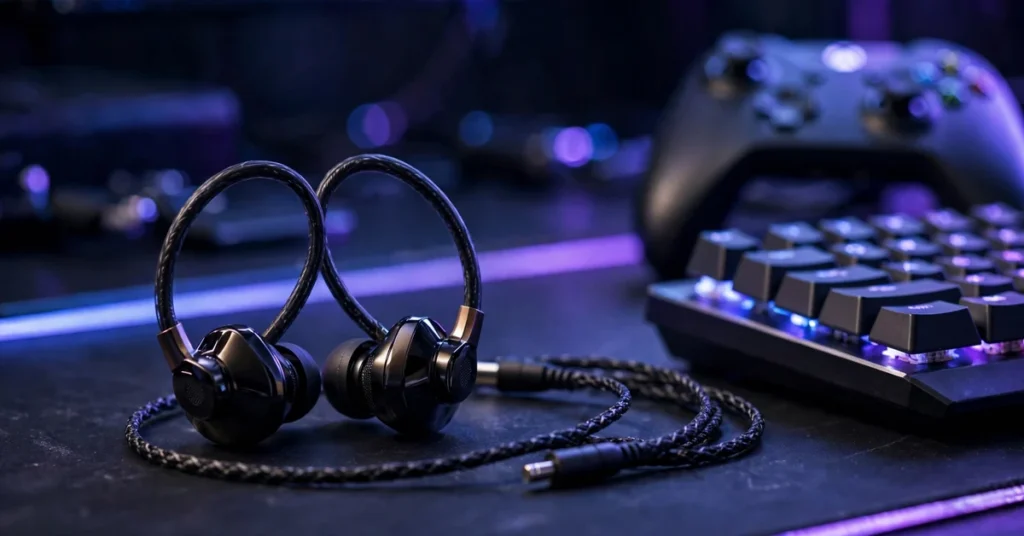
Chunky gaming headsets are great at keeping your head warm. They are less great at letting you hear an enemy reloading two rooms away. That is why a growing slice of competitive and casual players has switched to in-ear monitors (IEMs): wired earphones built for precise imaging, near-zero latency, and featherweight comfort over multi-hour sessions. We compared current IEM models against what gaming actually demands — positional accuracy, footstep clarity, mic options for team chat, and a fit that disappears during long queues — using manufacturer specs, live Amazon listing data, and consensus from competitive-FPS communities. The six picks below are the ones that clear that bar.
Updated October 2026 — our #1 pick for competitive play is the Truthear x Crinacle Zero: BLUE2.
How this guide was built: this is a research-based roundup. We did not run hands-on listening sessions for these picks; rankings weigh measured/driver data from manufacturers, verified listing details, and how each tuning serves gaming scenarios (imaging, footstep clarity, long-session comfort, chat options).
Our Top Picks at a Glance
Truthear x Crinacle Zero: BLUE2 — the best gaming IEM for competitive FPS: dual-dynamic-driver tuning built for pinpoint imaging and footstep clarity, with an in-line mic cable for team chat.
SIMGOT EM6L — the best all-rounder: a 1DD + 4BA hybrid with excellent positional audio that also pulls double duty for music between sessions.
Moondrop Chu II — the best ultra-budget gaming IEM: genuinely clean 10mm-driver sound and a detachable cable for almost nothing.
Best of the rest, by use case:
- final VR3000 — the best gaming-designed IEM, tuned specifically for spatial awareness with locking ear hooks and an in-line mic.
- Truthear GATE — the best ultra-affordable competitive pick, with mic cable and neutral-leaning tuning.
- SIMGOT EA500 LM — the best for tuning flexibility, with replaceable nozzles and a detachable silver-plated cable.
1. Truthear x Crinacle Zero: BLUE2 — Best for Competitive FPS

Key specs: 10mm + 7.8mm dual dynamic drivers · DLP-3D-printed cavity · Detachable 0.78 2-pin cable (3.5mm + in-line mic) · ~10Ω impedance · Recommended for gaming on listing
The Zero: BLUE2 is the current generation of the most-recommended FPS IEM in the hobbyist community, and it earned that reputation the honest way: a dual-dynamic-driver setup that delivers unusually precise left/right imaging and clean midrange detail where footsteps and reload cues live. The tuning avoids the bass bloat that buries positional cues on “gamer”-branded sets, while keeping enough low-end weight that gunfire still has impact.
The cable is the gaming-relevant detail: it includes an in-line microphone, so team chat works out of the box — no separate mic purchase, no adapter juggling on console controllers. The detachable 0.78 2-pin connection means the cable is replaceable if it frays, which is the single most common failure point on wired IEMs. One caveat: the nozzle is on the larger side, so players with small ear canals should try the included tips carefully first.
- Pros: Superb imaging and footstep clarity for FPS; mic cable included; detachable cable for longevity; avoids bass masking
- Cons: Larger nozzle may not suit small ears; not tuned for bass-heavy fun listening; no tuning switches
Our verdict: If your primary goal is winning gunfights, start here — nothing at this tier images better, and the mic cable removes the usual IEM-for-gaming compromise.
| Imaging & Soundstage | 9.6 |
| Footstep Clarity | 9.5 |
| Comfort (Long Sessions) | 8.4 |
| Mic / Chat Options | 8.8 |
| Music Versatility | 8.6 |
| Value | 9.2 |
2. SIMGOT EM6L — Best All-Rounder for Gaming and Music

Key specs: 1 dynamic driver + 4 balanced armatures (hybrid) · 3D-printed resin housing · Detachable OFC silver-plated cable · 3.5mm wired · 119dB sensitivity
If you want one pair that handles ranked nights and your music library without swapping, the EM6L is the community’s favorite answer. The hybrid configuration — a dynamic driver for bass and four balanced armatures for mids and treble — separates simultaneous sounds unusually well: gunfire, ability cues, and teammate callouts stay distinct instead of smearing together. The ergonomic resin shell is small and light, which matters when a session stretches past three hours.
For gaming, the EM6L’s tuning is the appeal: clean, detailed, and spacious, with the kind of resolution that makes directional audio easy to read, and Amazon lists it for gaming use. The honest trade-off is the microphone — the stock cable has no in-line mic, so Discord/party-chat players will want a cheap 2-pin mic cable or a standalone mic. The detachable design makes that upgrade painless.
- Pros: Excellent detail separation and positional audio; comfortable small shell; great stock cable; doubles as a music IEM
- Cons: No in-line mic in the box; upper mids can sound metallic at high volume; needs a mic-cable upgrade for chat
Our verdict: The best one-pair-does-everything pick — elite positional audio for games, genuinely enjoyable tuning for everything else.
| Imaging & Soundstage | 9.2 |
| Footstep Clarity | 9.0 |
| Comfort (Long Sessions) | 9.1 |
| Mic / Chat Options | 7.0 |
| Music Versatility | 9.4 |
| Value | 9.0 |
3. Moondrop Chu II — Best Budget Gaming IEM

Key specs: 10mm dynamic driver (aluminum-magnesium diaphragm) · Zinc-alloy cavity · Detachable 0.78 2-pin cable · 3.5mm wired · 18Ω, 119dB sensitivity
The Chu II is the budget pick that embarrasses products several times its cost. Moondrop’s 10mm dynamic driver is clean, balanced, and — critically for gaming — not tuned for bass fun at the expense of clarity. Footsteps and positional cues come through with surprising precision for the price tier, the zinc-alloy shell feels far more premium than its cost suggests, and the detachable cable is a genuine rarity at this level.
Two caveats for gamers. First, the standard 3.5mm version has no in-line microphone, so team chat needs a separate solution (a DSP/USB-C variant with a mic exists for jack-less phones). Second, the tuning is honest rather than exciting: immersive single-player epics will sound accurate but not cinematic. For competitive play on a tight budget, this is the “just get started” IEM the community recommends without hesitation.
- Pros: Outstanding clarity for the price; detachable cable; solid metal build; comfortable for long sessions
- Cons: No in-line mic on the 3.5mm version; restrained bass; needs a separate mic for team chat
Our verdict: The best gaming IEM under budget-tier pricing — clean imaging, honest tuning, and a cable you can replace.
| Imaging & Soundstage | 8.8 |
| Footstep Clarity | 8.9 |
| Comfort (Long Sessions) | 8.8 |
| Mic / Chat Options | 6.5 |
| Music Versatility | 8.9 |
| Value | 9.8 |
4. final VR3000 — Best IEM Designed Specifically for Gaming

Key specs: 6mm custom dynamic driver · In-line microphone + 3-button controls · Locking ear hooks · 3.5mm wired · 18Ω, 101dB sensitivity · 20g total weight
Most “gaming IEMs” are gaming in name only. The VR3000 is the exception: Japanese audio house final designed it from the ground up around spatial audio, tuning the 6mm driver so direction and distance cues arrive with accuracy rather than exaggeration. The result is a balanced, immersive presentation where you hear the game as its sound designers intended — no artificial bass boost smearing footsteps into explosions.
The practical details sell it for gaming marathons. Locking ear hooks keep the shells seated when you lean or fidget; at 20 grams total they are effectively weightless; and the in-line mic with three-button controller handles team chat without a separate device. The cable is detachable, five pairs of final’s own eartips are included for a proper seal (seal quality is what makes positional audio work), and compatibility is universal: PS5, Xbox, Switch, PC, and mobile all plug in via 3.5mm.
- Pros: Purpose-built gaming tuning for spatial accuracy; in-line mic included; locking ear hooks; featherweight; universal console compatibility
- Cons: Balanced tuning may feel restrained if you like bass; no tuning options; cable is functional rather than premium
Our verdict: The only pick engineered for games from day one — spatial accuracy, mic, and marathon comfort in one package.
| Imaging & Soundstage | 9.3 |
| Footstep Clarity | 9.0 |
| Comfort (Long Sessions) | 9.4 |
| Mic / Chat Options | 8.6 |
| Music Versatility | 8.0 |
| Value | 8.6 |
5. Truthear GATE — Best Ultra-Affordable Competitive Pick

Key specs: 10mm dynamic driver (carbon LCP diaphragm) · Detachable 0.78 2-pin cable (with-mic version) · 3.5mm wired · 28Ω, 122dB sensitivity · 7 pairs of eartips
The GATE is Truthear’s answer to the question “how cheap can a genuinely competitive gaming IEM get?” Its 10mm dynamic driver uses a carbon-LCP composite diaphragm, and the tuning leans neutral — exactly what you want when footstep clarity matters more than bass impact. At 122dB sensitivity it runs loud and clean off any controller or phone jack, no amp required.
What makes the GATE gaming-ready rather than just cheap is the package: this variant ships with a mic cable, seven pairs of eartips for dialing in a proper seal, and a detachable cable — the trifecta that budget IEMs almost never offer together. If the Chu II is the budget audiophile pick, the GATE is its competitive-gaming sibling: slightly more neutral, mic included, and tuned for cues over fun.
- Pros: Neutral tuning ideal for competitive cues; mic cable included; 7 eartip pairs for fit; detachable cable at a budget tier
- Cons: Not immersive for cinematic single-player; plastic shell; treble can feel lean on some sources
Our verdict: The cheapest way to get a mic, a detachable cable, and competitive-grade tuning in one box.
| Imaging & Soundstage | 8.7 |
| Footstep Clarity | 8.8 |
| Comfort (Long Sessions) | 8.6 |
| Mic / Chat Options | 8.5 |
| Music Versatility | 7.8 |
| Value | 9.4 |
6. SIMGOT EA500 LM — Best for Tuning Flexibility

Key specs: Dual-magnet, dual-cavity dynamic driver (2nd gen) · Replaceable tuning nozzles · Detachable silver-plated OFC cable · 3.5mm wired · Listed for gaming use
Different games want different sound. The EA500 LM’s party trick is a set of replaceable tuning nozzles that reshape the frequency response without EQ — dial toward treble emphasis for footstep detail in competitive shooters, or back toward a fuller curve for immersive RPGs. The second-generation dual-magnet, dual-cavity driver keeps distortion low, and the mirror-finish metal cavity is one of the best-built shells at this tier.
For gaming, the EA500 LM sits in a sweet spot between the EM6L’s hybrid detail and the VR3000’s purpose-built tuning: it images well, isolates well, and the nozzle system means one purchase adapts to both your Valorant nights and your Elden Ring weekends. Amazon lists it explicitly for gamer use. Like the EM6L, there is no in-line mic in the box — the one real compromise — so team-chat players should budget for a mic cable or standalone mic.
- Pros: Tuning nozzles adapt to competitive vs immersive play; low-distortion 2nd-gen driver; premium metal build; detachable cable
- Cons: No in-line mic included; nozzle swapping is fiddly; heavier than resin-shell rivals
Our verdict: One IEM, two personalities — the flexible pick for players who switch between competitive and cinematic games.
| Imaging & Soundstage | 8.9 |
| Footstep Clarity | 8.8 |
| Comfort (Long Sessions) | 8.5 |
| Mic / Chat Options | 7.0 |
| Music Versatility | 8.9 |
| Value | 8.7 |
Comparison Table
| Product | Driver | Mic included | Rating |
|---|---|---|---|
| Truthear x Crinacle Zero: BLUE2 | Dual dynamic | Yes, in-line | 9.1/10 |
| SIMGOT EM6L | 1DD + 4BA hybrid | No | 8.9/10 |
| final VR3000 | 6mm dynamic | Yes, in-line | 8.8/10 |
| Moondrop Chu II | 10mm dynamic | No | 8.7/10 |
| SIMGOT EA500 LM | Dual-magnet dynamic | No | 8.6/10 |
| Truthear GATE | 10mm dynamic | Yes, in-line | 8.5/10 |
Why You Should Trust SoundMavericks
SoundMavericks covers noise-cancelling and gaming audio full-time — from our budget ANC headphone roundup to explainers like Bluetooth audio codecs. For this guide we worked the way we always do: compare manufacturer driver data and tunings, verify every product listing is live and correct on Amazon (each ASIN above was checked against its product title), weigh long-running consensus from competitive-FPS communities, and score against what gaming actually needs — not what looks good on a spec sheet. We do not sell placement; rankings reflect the analysis, and affiliate links fund the work.
How We Chose These IEMs
Gaming rewards a different sound signature than music listening. We scored each IEM on five gaming-specific criteria: imaging and soundstage (can you place a sound in 3D space?), footstep clarity (do midrange cues cut through effects?), long-session comfort (shell weight, fit stability, heat), mic/chat options (in-line mic or easy cable upgrade), and music versatility (because most players listen to more than game audio). Zero-latency wired connection was a hard requirement — every pick here plugs in over 3.5mm, sidestepping the Bluetooth latency problem entirely. If you want the wireless side of the story, our noise-cancelling earbuds guide and Auracast explainer cover where low-latency wireless is heading.
Buying Guide: What Makes an IEM Good for Gaming
Imaging matters more than soundstage
Reviews talk about soundstage (how wide the sound feels), but gamers should care more about imaging — how precisely sounds are placed within that space. A wide but vague soundstage is useless in a firefight; a tight, accurate image tells you the enemy is behind the wall to your left. Multi-driver designs like the Zero: BLUE2 and EM6L tend to image better because each driver handles a narrower frequency band.
Tuning: neutral wins for competitive, fun wins for immersion
Footsteps, reloads, and ability cues live in the midrange, and bass-heavy tunings mask them — which is why competitive players favor neutral IEMs like the GATE and Zero: BLUE2. If you mostly play cinematic games, a fuller tuning (or the EA500 LM’s adjustable nozzles) gives explosions and soundtracks more weight without sacrificing dialogue clarity.
Latency: wired is still king
Every pick in this guide is wired, and that is deliberate. Bluetooth adds 40–60ms of latency even on low-latency earbuds, while a 3.5mm cable is effectively zero. If your phone dropped the headphone jack, a cheap USB-C DAC dongle restores wired audio; our codec explainer breaks down why wireless audio always involves a compromise.
Fit, seal, and comfort for long sessions
IEMs beat headsets on marathon comfort — no clamping force, no sweaty earcups — but only if the seal is right. A bad seal kills bass response and ruins imaging, so experiment with the included eartips; foam tips add passive isolation that helps you focus. Ear hooks (like the VR3000’s locking design) keep shells seated during movement — handy if you also game on the move; see our gym headphones guide.
Don’t forget the microphone
Three of our six picks ship with an in-line mic (Zero: BLUE2, VR3000, GATE). For the others: a replacement 2-pin cable with a mic (cheap, and every detachable pick here supports it) or a standalone USB/desktop mic for better voice quality. Team-chat players should lean toward the mic-included picks.
FAQ
Are IEMs good for gaming?
Yes — often better than gaming headsets for competitive play. IEMs offer near-zero latency over a wired connection, excellent imaging for positional audio, passive isolation from room noise, and far better long-session comfort than clamped over-ears. Their main weakness is microphones, which is why mic-cable options matter.
Which IEM is best for hearing footsteps in FPS games?
The Truthear x Crinacle Zero: BLUE2 is our top pick for footstep clarity: its dual-dynamic-driver tuning emphasizes the midrange detail where footsteps live without bass masking them. The SIMGOT EM6L and Truthear GATE are strong alternatives, and the SIMGOT EA500 LM’s treble-leaning nozzle can be tuned toward cue detail.
Do wired IEMs have less latency than wireless gaming earbuds?
Yes. A wired 3.5mm connection has effectively zero latency, while even purpose-built low-latency wireless earbuds typically add 40–60ms — enough to notice when audio cues decide fights. For competitive play, wired remains the safest choice.
Can I use IEMs with PS5, Xbox, and Nintendo Switch?
Yes. Every IEM in this guide uses a standard 3.5mm connection, which plugs directly into the DualSense and Xbox controllers, the Switch’s headphone jack, and PC front-panel audio. If your phone or laptop lacks a jack, a USB-C DAC dongle works fine.
How do I get a microphone with IEMs that don’t include one?
Three options: buy a 2-pin replacement cable with an in-line mic (inexpensive, and all our detachable-cable picks support it), use a standalone USB or headset mic for better quality, or choose a pick that ships with a mic — the Zero: BLUE2, final VR3000, and Truthear GATE all include one.
Are expensive IEMs worth it for casual gaming?
Not necessarily. The Moondrop Chu II and Truthear GATE deliver genuinely competitive imaging at budget pricing — diminishing returns kick in fast for gaming specifically. Spend more (EM6L, EA500 LM) when you also want the IEM to double as your music earphone.

I am the founder of Sound Mavericks, where I provide the polite truth about audio equipment. I started this site because consumer electronics reviews are often too technical. Instead of using a silent lab, I test headphones, earbuds, and Bluetooth speakers in the real world – like on a noisy subway or in a busy coffee shop.
To stay independent, I buy my own review units (mostly from the United States) rather than accepting free gifts from brands. Once I finish testing a product, I sell it locally to our community. My goal is to help you understand sound quality, active noise cancellation (ANC), and battery life without the marketing hype.