
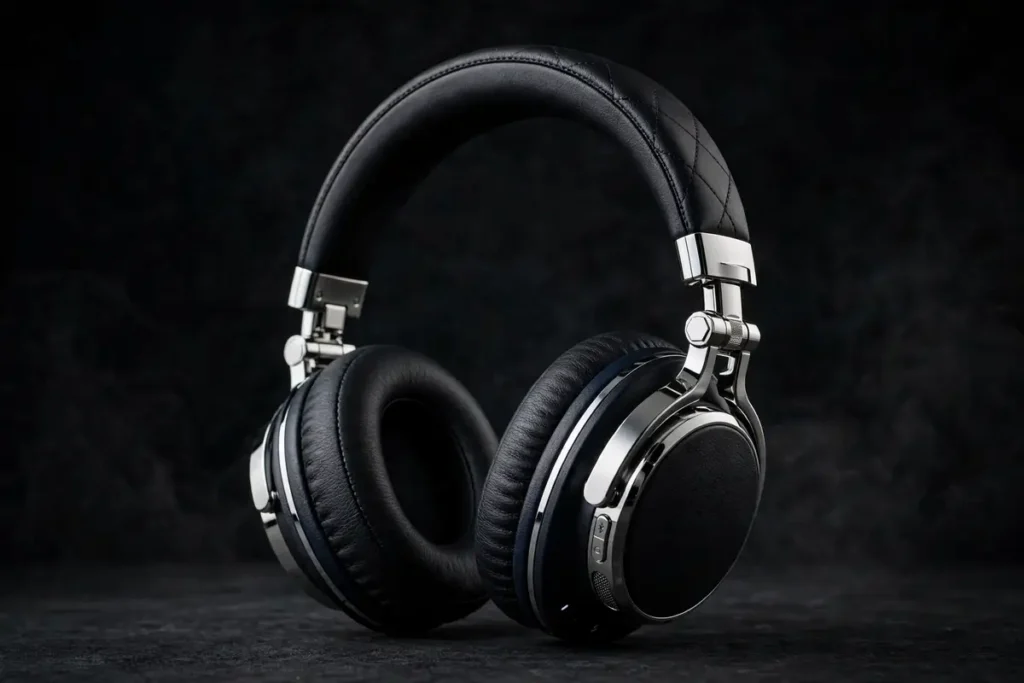
This noble audio fokus artemis review covers Noble Audio’s flagship wireless over-ear, a distinct model that sits above the FoKus Apollo in the range and should not be confused with the FoKus Rex5 or Amadeus earbuds or the Prestige line, which have their own pages here. The Artemis is built around a three-driver hybrid system, one dynamic driver, one planar driver and one balanced armature driver per ear, running on Qualcomm’s QCC3095 platform with Bluetooth 6.0, LDAC and aptX Lossless. It is Noble betting that wireless buyers will pay flagship money for driver hardware borrowed from the in-ear world.
A note on method. This review is research-based and the scores are provisional. There is no record for the Artemis in our headphone database yet, so the score set below is built from Noble’s published specifications and the spread of hands-on verdicts from reviewers who have tested it, including the ones who disagreed with each other. Where reviewers split, we say so rather than averaging the disagreement away. We have not handled a unit for this page, and nothing here claims hands-on testing.

Noble Audio FoKus Artemis 7.8/10
Why you: you want the most ambitious driver hardware in a wireless over-ear. Three driver types per ear, the full LDAC and aptX Lossless codec set, Audiodo hearing personalisation stored on the headphone, and a replaceable battery make the Artemis the specification outlier in its class.
Trade-off: the stock tuning divides reviewers sharply, the noise cancelling is a tier below the Bose and Sony leaders, and the price is flagship money with no discount story. Set up the personal sound profile or the balance may not suit you.
Bluetooth 6.0 · LDAC · aptX Lossless · Triple hybrid drivers · Variable ANC · 35-hour ANC battery
Sound quality: three drivers, two camps
Sound scores 8.6, with an asterisk this review will not hide. The hardware case is real: a 40mm dynamic driver handles the low end, a 14.5mm planar driver covers speed and upper-midrange clarity, and a balanced armature tweeter adds top-end extension, an arrangement no mainstream wireless rival attempts. TechRadar called the result some of the most spacious, hypnotic sound it has heard from wireless headphones, Headfonics scored sound quality at 9 for its taut bass and detail retrieval, and MusicTech praised a wide, open stage that ANC headphones rarely manage.
The other camp exists and is specific. A measurement-led review at headphones.com found the stock tuning bass-heavy to the point of burying midrange detail, with a harsh upper treble peak its reviewer could not correct with the app EQ, and rejected the headphone outright. Our read of the split is that seal and personalisation decide which Artemis you hear: the fit sits looser than average, which shifts bass and treble, and the Audiodo Personal Sound profile, which tests your hearing per ear and stores the result on the headphone, changes the balance a great deal. Buyers who set it up carefully tend to land in the praise camp. Noble’s own line shows the same sound-first priorities at other prices in our Noble FoKus Apollo review and Noble FoKus Rex5 review, and the Artemis is that idea pushed to its limit.
Noise cancelling and calls
ANC scores 7.0. The Artemis offers variable cancelling in low, mid and high settings plus a transparency mode, driven by its seven-microphone system. Reviewers agree on the shape of the result: office noise, typing and light chatter are handled well, while engine roar and passing traffic still get through, partly because the looser fit lets sound leak past the cushions before the electronics can help. That places it a clear tier below the strongest Bose and Sony models in our best wireless headphones coverage, and buyers who fly weekly for quiet should weigh that honestly.
Calls score 8.2, the quiet strength of the feature set. The seven microphones keep voices clear and natural in quiet and moderate noise, and reviewers who recorded test calls reported speech that never turned thin or buried. Multipoint keeps two devices connected, wear detection pauses playback when you lift the headphones off, and the physical button controls avoid the missed swipes of touch panels. As a work headphone that also plays music seriously, the Artemis is better rounded than its sound-first reputation suggests.
Design, comfort and ownership
Comfort scores 8.0. At 324g the Artemis is lighter than most metal-and-leather flagships, the headband padding is generous, and the CNC aluminium cups carry an etched Damascus-style pattern that looks like nothing else in the class. The looser fit that helps long-session comfort is the same trait that weakens passive isolation, so smaller heads should expect to adjust the seal deliberately. IP52 dust and water resistance is unusual on an over-ear and useful for commutes in bad weather.
The ownership story is the best in the wireless flagship class. The 600mAh battery is user-replaceable, the ear cushions attach magnetically and swap in seconds, and Noble rates playback at over 35 hours with ANC on and over 55 hours with it off, charging in under 90 minutes. Battery scores 8.4 on the strength of runtime plus replaceability together. Wired listening covers both USB-C audio and a 3.5mm cable that works with the headphone switched off. Against the other hi-fi-led wireless flagship in our Focal Bathys review, the Artemis counters with newer Bluetooth, a wider codec list and parts you can renew yourself.
Noble Audio FoKus Artemis specs
| Spec | Noble Audio FoKus Artemis |
|---|---|
| Design | Over-ear, closed-back, wireless with active noise cancelling |
| Drivers | Triple hybrid per ear: 40mm dynamic, 14.5mm planar magnetic, balanced armature tweeter |
| Bluetooth | 6.0, Qualcomm QCC3095, multipoint |
| Codecs | SBC, AAC, aptX Adaptive, aptX Lossless, LDAC |
| Noise cancelling | Variable ANC, low, mid and high, plus transparency mode, 7 microphones |
| Battery | Over 35 hours with ANC, over 55 hours without, 600mAh user-replaceable, under 90 minutes to charge |
| Wired listening | USB-C audio and 3.5mm cable |
| Frequency response | 10 Hz to 40 kHz |
| Personalisation | Audiodo Personal Sound, Audiosphere spatial audio, EQ stored on the headphone |
| Weight | 324g |
| Water resistance | IP52 |
Verdict
Buy the Artemis if you shop wireless headphones the way hi-fi buyers shop wired ones: driver hardware first, codecs in full, parts you can replace, and a sound you are willing to tune to your own hearing. The 7.8 overall is a provisional score that respects both camps of the review split, with the 8.6 Sound bar assuming you set up the personal profile and get a proper seal.
Skip it if you want the quietest cabin, a safe out-of-the-box tuning, or flagship features at a mainstream price. Value scores 6.8 because the asking price leaves no room for its weaknesses. Noble’s earbud flagship in our Noble FoKus Amadeus review shows the same philosophy in a smaller form for buyers who prefer to travel lighter.
Frequently asked questions
How is the FoKus Artemis different from the FoKus Apollo?
The Artemis is Noble’s newer flagship over-ear and sits above the Apollo. The Apollo uses a hybrid two-driver setup; the Artemis adds a third driver type, a balanced armature tweeter, alongside its dynamic and planar drivers, and moves to Bluetooth 6.0 on the Qualcomm QCC3095 platform with LDAC and aptX Lossless. It also adds Audiodo Personal Sound, Audiosphere spatial processing and a user-replaceable battery. The two models have separate reviews on this site and separate listings.
What codecs does the FoKus Artemis support?
LDAC, aptX Lossless, aptX Adaptive, AAC and SBC over Bluetooth 6.0. That is the full high-resolution set: Android phones with Snapdragon Sound can use aptX Lossless, Sony-style LDAC devices are covered, and iPhones run over AAC. Wired listening is available over USB-C audio and a 3.5mm cable.
How good is the Artemis noise cancelling?
Useful, not class-leading. ANC scores 7.0 here. The variable system has low, mid and high settings plus a transparency mode, and reviewers found it handles office noise, typing and light chatter well, while engine roar and traffic still seep in, helped by a fit that sits looser than the tightest-sealing rivals. Buy it for sound first and treat the cancelling as a supporting feature.
Why do Artemis reviews disagree about the sound?
Because the stock tuning is bold and the fit affects what you hear. Several reviewers rate the Artemis among the best-sounding wireless headphones they have tested, praising its space, bass weight and detail. At least one measurement-led review found the bass overbearing and the treble harsh, and could not fix it with the app EQ. The Audiodo Personal Sound profile changes the result a lot, so your mileage depends on setting it up and on the seal you get.
How long does the Artemis battery last, and can it be replaced?
Noble rates the Artemis at over 55 hours with ANC off and over 35 hours with ANC on, with a full charge in under 90 minutes. Battery scores 8.4. The 600mAh battery is user-replaceable, which is rare in a wireless flagship, and the ear cushions attach magnetically and can also be swapped, so the two parts that age first can both be renewed.

I am the founder of Sound Mavericks, where I provide the polite truth about audio equipment. I started this site because consumer electronics reviews are often too technical. Instead of using a silent lab, I test headphones, earbuds, and Bluetooth speakers in the real world – like on a noisy subway or in a busy coffee shop.
To stay independent, I buy my own review units (mostly from the United States) rather than accepting free gifts from brands. Once I finish testing a product, I sell it locally to our community. My goal is to help you understand sound quality, active noise cancellation (ANC), and battery life without the marketing hype.
