
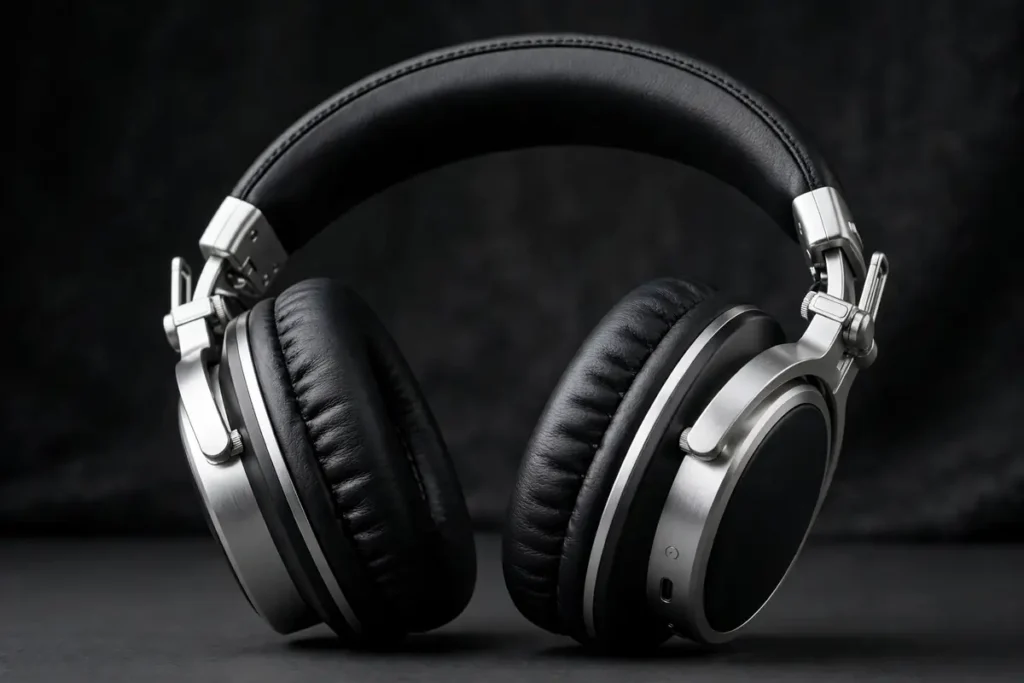
This noble fokus apollo review covers the Noble FoKus Apollo, Noble Audio’s first over-ear headphone, an ANC flagship built around a hybrid driver pairing no rival uses: a 40mm dynamic driver and a 14.5mm planar magnetic driver in each cup. It is not the later Apollo Pro. The Apollo reviewed here adds a detachable boom microphone, wired listening and very long battery life, and it scores 8.3 overall in our provisional scoring, with Sound at 9.0 and Battery at 9.2.
A note on method. This review is research-based, with provisional scores built from published measurements and review consensus for this exact model. One listing note: we could not verify a current Amazon US page for the original Apollo while Amazon’s bot wall is up, so buy links point to an Amazon search for the model, and no product image is shown.
Noble FoKus Apollo 8.3/10
Why you: you want a wireless over-ear built for sound first. A 40mm dynamic driver and a 14.5mm planar driver share each cup, battery life is measured in days, and a detachable boom mic handles calls properly.
Trade-off: the price sits well above the mainstream flagships, the headphone is not light, and the cancelling, while good, is not the quietest available. Value scores 6.8 for exactly that reason.
Over-ear ANC · 40mm dynamic + 14.5mm planar hybrid · Bluetooth 5.3 · LDAC and aptX HD · Boom microphone · Up to 80 hours
Sound quality
Sound scores 9.0. The hybrid layout splits the work by strength: the dynamic driver gives bass physical weight, the planar unit handles mids and treble with the speed planar drivers are known for, and the two share a common acoustic point so they blend rather than step on each other. Reviewers with measurements and long listening time agree on the result: a full, detailed presentation that sounds closer to Noble’s wired IEMs than to a typical Bluetooth headphone.
Codec support backs the hardware. LDAC and aptX HD cover high-bitrate Android listening, with AAC and SBC for everything else, and wired playback over USB-C or 3.5mm removes Bluetooth from the chain when you want the best of it. Our Focal Bathys review covers the closest sound-first rival, which takes a different route to the same goal.
Noise cancelling and calls
ANC scores 7.4. The Apollo’s hybrid cancelling takes flights and office hum down convincingly, and it does so without squeezing the music, which is where sound-first rivals often fail. It is not the quietest headphone in the class: the leading Bose and Sony models cancel more, particularly voices. Buyers choosing on silence alone should start from our best noise-cancelling headphones guide.
Calls score 8.4, the best call result among sound-first flagships, because Noble includes a detachable boom microphone in the box. With the boom fitted, your voice sits close to the pickup and calls stay clear in conditions where cup microphones smear. Without it, the built-in mics are ordinary. The boom also suits gaming and long meeting days, helped by multipoint connections to two devices.
Comfort, battery and everyday use
Comfort scores 8.2. Aluminium hardware, memory foam pads and a well-judged clamp make long sessions easy, though the Apollo is a substantial headphone and smaller heads should expect to notice the weight by the third hour. The case, cables and adapters in the box are generous, airline adapter included.
Battery scores 9.2. Noble rates up to 80 hours with cancelling off and around 60 hours with it on, figures reviewers found realistic, which means charging becomes a monthly habit rather than a weekly one. Value scores 6.8: the Apollo costs more than the mainstream flagships it out-sounds, and the gap buys drivers and battery, not the strongest cancelling or the richest app.
How it compares
Against the Focal Bathys, the Apollo counters with longer battery life, a boom microphone and planar-assisted treble, while the Bathys answers with its USB-DAC mode and a slightly richer midrange. Both are sound-first answers to the same question, and the choice between them comes down to calls and battery on one side, wired DAC listening on the other.
Against the mainstream flagships from Bose, Sony and Apple, the Apollo sounds better to most trained ears, cancels less, and costs more. Its app and ecosystem are also plainer. That is the honest shape of the audiophile corner of this market: you trade polish and silence for drivers, and the Apollo makes that trade more completely than most.
Ownership notes
The Apollo rewards owners who use the whole box. The boom microphone transforms calls, the wired modes transform desk listening, and the case and adapters cover travel cases rivals charge extra to solve. Leaving the boom in the case and listening over SBC is buying a flagship and using a third of it.
Size is the daily reality: this is a substantial headphone that travels in a substantial case, and commuters with small bags should picture that honestly. In return, charging becomes rare enough to forget, the materials age gracefully, and the headphone feels like equipment rather than a gadget cycle purchase. That ownership character is what the price buys beyond the spec sheet.
Who it suits
The Apollo suits listeners who buy one headphone to do everything at a high level: music first, calls properly, travel comfortably, charging rarely. It suits home workers whose meeting days are long and whose music standards are higher. It does not suit buyers chasing maximum silence, minimum weight or minimum spend, and it never pretended to.
It also suits owners who keep equipment for years. The materials, the wired fallbacks and the replaceable boom point to a long service life, and the battery size means degradation arrives later than on smaller cells. Judged as a multi-year purchase rather than a gadget cycle, the value picture improves beyond what the 6.8 bar suggests.
Where it sits in Noble’s range
Noble built its reputation on in-ear monitors, from universals to customs costing many times the Apollo’s price, and the Apollo was the moment that tuning culture met the over-ear wireless market. The hybrid driver idea came straight from its IEM work, where multi-driver layouts are normal, transplanted into a format where one dynamic driver is the rule. That lineage explains both the sound and the price, and it is why the Apollo is judged against wired-flagship standards in this review.
Noble FoKus Apollo specs
| Spec | Noble FoKus Apollo |
|---|---|
| Design | Over-ear, closed, wireless with active noise cancelling |
| Drivers | 40mm dynamic driver + 14.5mm planar magnetic driver per side |
| Bluetooth | 5.3 with multipoint |
| Codecs | LDAC, aptX HD, aptX, AAC, SBC |
| Noise cancelling | Hybrid active noise cancelling |
| Battery | Up to 80 hours (ANC off), up to 60 hours (ANC on) |
| Microphone | Detachable boom microphone plus built-in mics |
| Wired listening | USB-C and 3.5mm |
| Model note | Original FoKus Apollo. Not the Apollo Pro |
Verdict
Buy the Apollo if sound quality leads and calls matter too. A 9.0 Sound score, a 9.2 Battery score and the boom microphone describe the most complete audiophile-leaning ANC headphone we have scored in this batch.
Skip it if price or maximum silence leads. The 8.3 overall is a provisional score for a flagship that spends its money on drivers, battery and a proper microphone, in that order.
Frequently asked questions
What drivers does the FoKus Apollo use?
Two per side: a 40mm dynamic driver and a 14.5mm planar magnetic driver, arranged to share an acoustic point. It was the first headphone to use this hybrid pairing, and it is the main reason the Apollo sounds different from other Bluetooth flagships.
Is the FoKus Apollo the same as the Apollo Pro?
No. The Apollo Pro is a later, pricier revision with different tuning. This review covers the original Apollo only, and no Pro specifications or scores are used here.
How good is the Apollo noise cancelling?
Good but not class-leading. ANC scores 7.4 here: strong on engine and office rumble, less total than the top Bose and Sony models on voices. The Apollo’s priority is sound, and its cancelling supports that rather than leading the pitch.
How long does the Apollo battery last?
Up to 80 hours with noise cancelling off and around 60 hours with it on, which scores 9.2. In practice that is weeks of commuting between charges.
Why does the Apollo include a boom microphone?
For calls and gaming. The detachable boom puts the microphone near your mouth, and calls score 8.4 with it fitted, well above what cup microphones manage. It plugs in when needed and stores in the case when not.

I am the founder of Sound Mavericks, where I provide the polite truth about audio equipment. I started this site because consumer electronics reviews are often too technical. Instead of using a silent lab, I test headphones, earbuds, and Bluetooth speakers in the real world – like on a noisy subway or in a busy coffee shop.
To stay independent, I buy my own review units (mostly from the United States) rather than accepting free gifts from brands. Once I finish testing a product, I sell it locally to our community. My goal is to help you understand sound quality, active noise cancellation (ANC), and battery life without the marketing hype.
