
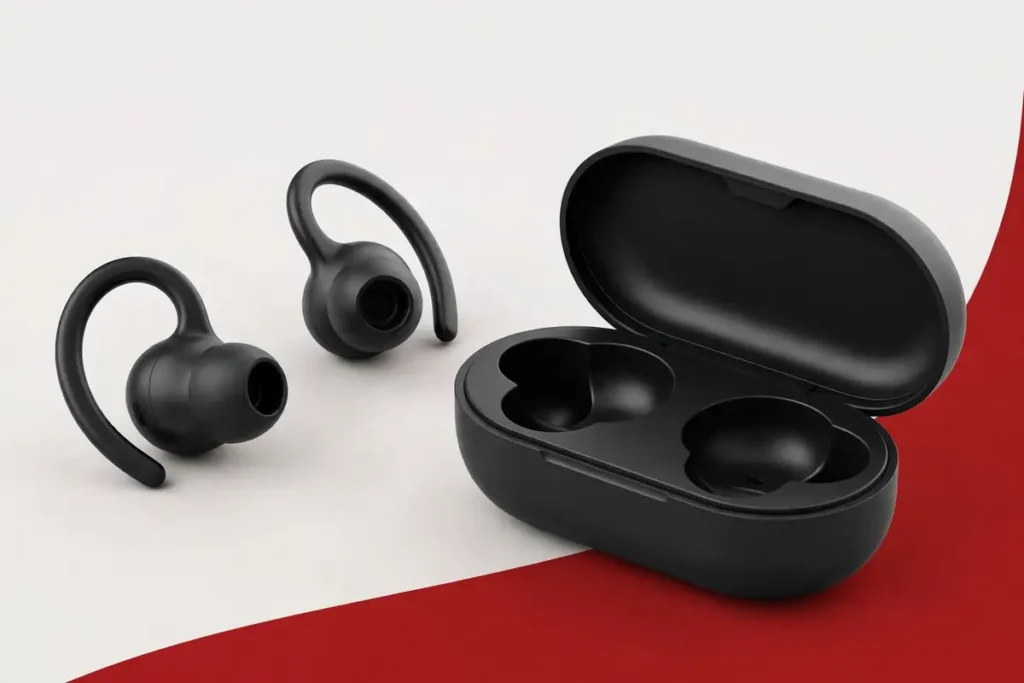
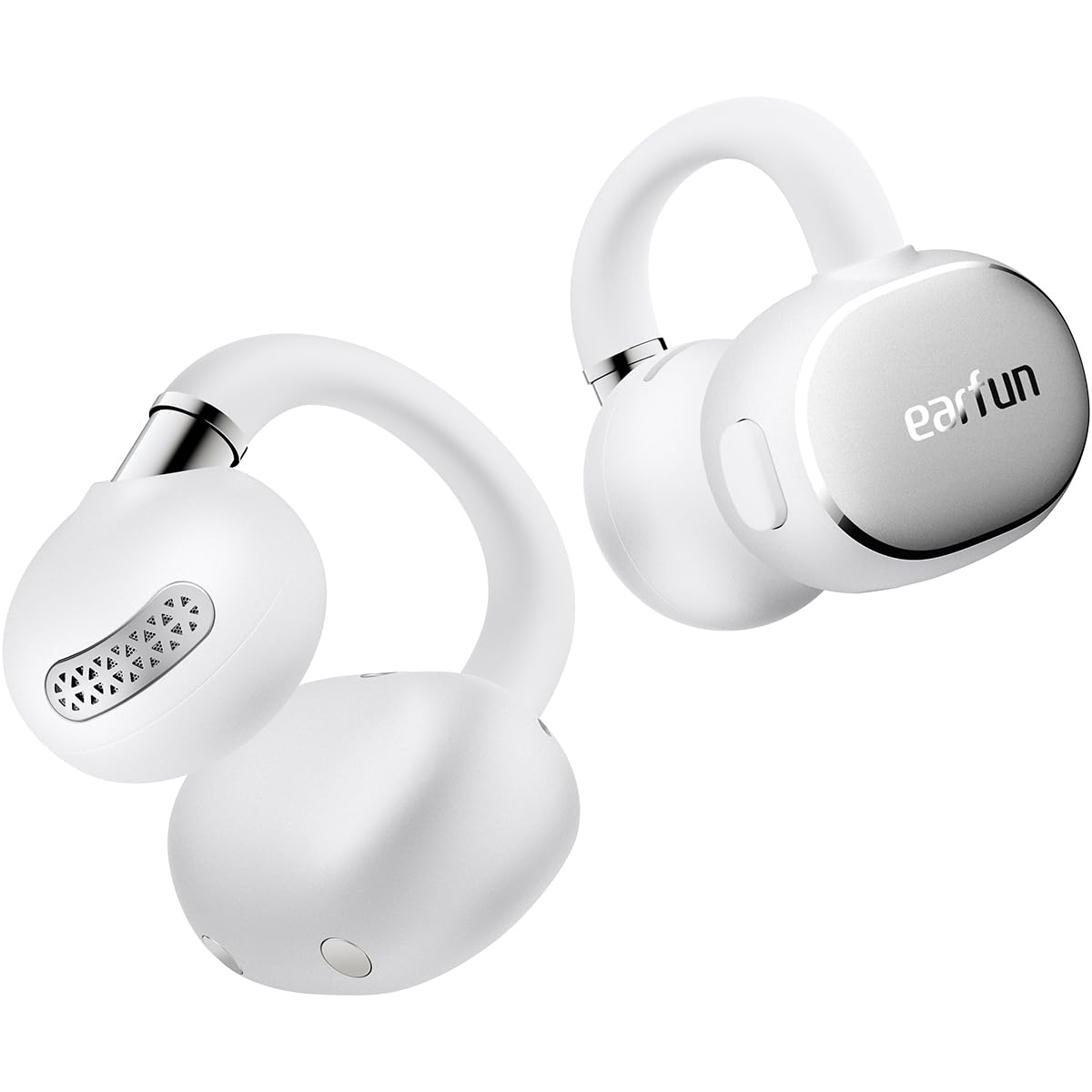
This EarFun Clip 2 review covers the open-ear earbud that clips onto the ear instead of sealing inside it: a 12mm titanium-composite driver per side, LDAC streaming over Bluetooth 6.0, and a four-microphone call system that reviewers keep singling out. The Clip 2 (model CW200B) sits in the budget half of the clip-on class and argues that the format’s usual weakness, call quality, does not have to be weak at all.
A note on method, and on buying. This is a research-based review: the scores are our provisional assessment, built from EarFun’s published specifications and the measured verdicts of specialist reviewers, set on the same scale as our headphone database. Nothing here is presented as hands-on lab testing. On availability, one honest note: this model only recently gained a US listing, and our links point to that listing page. Confirm the seller before buying, and check the listing matches the EarFun Clip 2 name and the CW200B designation.
EarFun Clip 2 7.2/10
Why you: you want open-ear awareness with calls that actually work. Four microphones with AI noise reduction score 7.8, the best call result in the clip-on class, and the 5.5-gram clip fit scores 8.6 for comfort because there is nothing in your ear canal at all.
Trade-off: open-ear sound cannot match a sealed bud for bass or detail, and there is no AAC, so iPhone listening runs over SBC. Battery also halves when LDAC is on. The format’s awareness is the feature; the physics is the price.
Bluetooth 6.0 · LDAC · 11 h buds, 40 h with case · IP55 · 5.5 g per bud · Multipoint
Sound quality
Open-ear physics sets the terms. The driver sits outside the canal and fires sound across a small air gap, so deep bass mostly escapes and absolute detail sits below what a sealed bud delivers. Within those terms, the Clip 2 does well. Its 12mm dual-magnetic driver with a titanium-composite diaphragm is large for the class, and the tuning keeps voices and midrange instruments clear, which is what podcasts, calls and everyday playlists actually need. Sound scores 7.2, a strong figure for the open format rather than a claim against sealed rivals.
Codec support needs one clear statement, because third-party databases disagree. EarFun’s own specification lists LDAC and SBC. One gear database also claims AAC; the brand’s spec and measured reviews do not support it, so this review does not promise it. Android owners with LDAC phones get the high-quality stream and the best sound the buds can make. iPhone owners get SBC, which on an open-ear design loses less than it would on a sealed one. Know which phone you own before weighing this model against the alternatives in our best open-ear earbuds coverage.
Volume and leakage follow the format too. In quiet rooms the Clip 2 plays plenty loud, and people nearby hear little at normal levels. In loud environments the open design cannot compete with the noise around you, and pushing the volume just adds your music to it. That is the standing bargain of every clip-on bud, priced into the ANC bar below rather than hidden.
No noise cancelling, by design
The ANC score of 1.8 is the lowest bar on the card and the most misunderstood. There is no noise cancelling and no seal, so the buds block almost nothing: traffic, office chatter and street sound all remain audible alongside your audio. For the buyers this format serves, that is the feature. Runners and cyclists keep their awareness of the road, office workers hear a colleague say their name, and parents hear the house. The Sony rival in our Sony LinkBuds Clip review makes the same trade for the same reasons.
Judge the Clip 2 against that purpose. If your listening happens on planes or in loud shared spaces and you need quiet, no open-ear bud is the right tool, and a sealed ANC model will serve you better at any price. If your listening happens outdoors or in places where isolation would be a hazard, the 1.8 is not a failure; it is the receipt for the awareness you bought.
Calls and microphones
Calls are where the Clip 2 separates itself. Four microphones with AI noise reduction work on your voice, and the result scores 7.8, well above the open-ear class norm and above many sealed buds. Review coverage of the model repeatedly names it among the best clip-on buds for calls, and the reason is simple: open-ear buds usually place their mics badly and process them lightly, and EarFun did neither. Voices stay intelligible in street noise that reduces most rivals in this format to a mumble.
The same system powers the model’s headline extras, including an AI translation feature in the companion app. Treat that as a bonus rather than a reason to buy; translation features vary by language pair and connection. The durable strength is the ordinary one: you can take a call on a walk, in wind, at a station, and be understood. For buyers whose earbuds double as their phone headset, that may matter more than any sound score on this page.
Multipoint Bluetooth 6.0 keeps two devices connected, so the buds can sit with a laptop for music and still answer the phone. The Soundcore rival in our Soundcore AeroClip 2 review is the closest comparison in this class, and calls are the ground where the EarFun makes its stand.
Comfort and fit
Comfort scores 8.6, the second-highest bar on the card. Each bud weighs 5.5 grams and clips over the ear with a soft bridge, putting nothing inside the canal and pressing nothing into it. The zero-pressure fit is the format’s core promise, and the Clip 2 keeps it through long sessions: no ear fatigue, no seal to break when you smile or chew, no tips to size. Glasses wearers should still check the clip against their frames, since both want the same strip of ear.
Security is the related question, and the clip design answers it well. A bud that hooks over the ear stays put through running and training in a way loose open buds resting in the ear’s bowl sometimes do not. The IP55 rating covers sweat, rain and dust, so weather is not a reason to leave them home. They are not swimming earbuds and should not be submerged; for everything short of the pool, the rating is enough.
Battery life and charging
Battery scores 9.2. EarFun rates the buds at 11 hours per charge and 40 hours in total with the case, and independent measurement has landed close to the per-charge figure, which is rare enough at this tier to be worth saying. In practice that is a working week of runs and commutes between case charges, or several full days of desk use.
The codec is the one lever that moves the numbers. With LDAC streaming switched on, endurance drops to about 6 hours per charge and 22 hours with the case. Android listeners should decide whether the stream quality is worth roughly half the battery; for podcasts and calls, it plainly is not, and the app makes switching easy. The case supports wireless charging as well as USB-C, which suits a bud set that lives on a desk pad between outings.
EarFun Clip 2 specs
| Spec | EarFun Clip 2 |
|---|---|
| Driver | 12mm dual-magnetic titanium-composite dynamic |
| Model | CW200B |
| Noise control | None (open-ear clip design, no seal) |
| Battery | 11 hours per charge, 40 hours with case (6 hours / 22 hours with LDAC on) |
| Codecs | LDAC, SBC (no AAC) |
| Bluetooth | 6.0 with multipoint (two devices at once) |
| Weight | 5.5 g per earbud |
| Water resistance | IP55 (sweat, rain and dust) |
| Extras | 4-mic AI call noise reduction, wireless charging case |
Verdict
Buy the EarFun Clip 2 if you want open-ear buds that take calls seriously. Calls at 7.8, comfort at 8.6, battery at 9.2 and value at 8.8 make a strong card for the format, and the 7.2 overall holds up once the 1.8 ANC bar is read as the format’s receipt rather than a fault. For runners, cyclists and office listeners who need their surroundings audible, this is one of the easiest recommendations in the clip-on class.
Skip it if you need isolation, if deep bass is your priority, or if you are an iPhone listener who expected AAC. A sealed earbud serves all three needs better. The Clip 2 is built for awareness first, and everything good about it follows from that choice.
Frequently asked questions
Does the EarFun Clip 2 support AAC?
No. EarFun’s own specification lists LDAC and SBC only, despite one third-party database claiming AAC. Android phones with LDAC get the high-quality stream; iPhones fall back to SBC, which still sounds respectable on an open-ear design but is worth knowing before you buy.
Does the EarFun Clip 2 have noise cancelling?
No, and by design. The Clip 2 is an open-ear bud that clips on without sealing the canal, so you hear the world around you along with your music. That awareness is the point of the format, for running, cycling and office use.
How long does the EarFun Clip 2 battery last?
EarFun rates the buds at 11 hours per charge and 40 hours in total with the case, and independent testing has measured close to the per-charge claim. With LDAC switched on the figures drop to about 6 hours per charge and 22 hours with the case, so codec choice is the big battery decision.
Is the EarFun Clip 2 good for calls?
Calls are its standout strength. Four microphones with AI noise reduction score 7.8 in this review, and the model is repeatedly named among the best clip-on buds for call quality. Voices stay clear in conditions where most open-ear buds give up.
Is the EarFun Clip 2 water resistant?
Yes, rated IP55, which covers sweat, rain and dust. It suits running and training in bad weather. It is not a swimming earbud and should not be submerged.

I am the founder of Sound Mavericks, where I provide the polite truth about audio equipment. I started this site because consumer electronics reviews are often too technical. Instead of using a silent lab, I test headphones, earbuds, and Bluetooth speakers in the real world – like on a noisy subway or in a busy coffee shop.
To stay independent, I buy my own review units (mostly from the United States) rather than accepting free gifts from brands. Once I finish testing a product, I sell it locally to our community. My goal is to help you understand sound quality, active noise cancellation (ANC), and battery life without the marketing hype.
