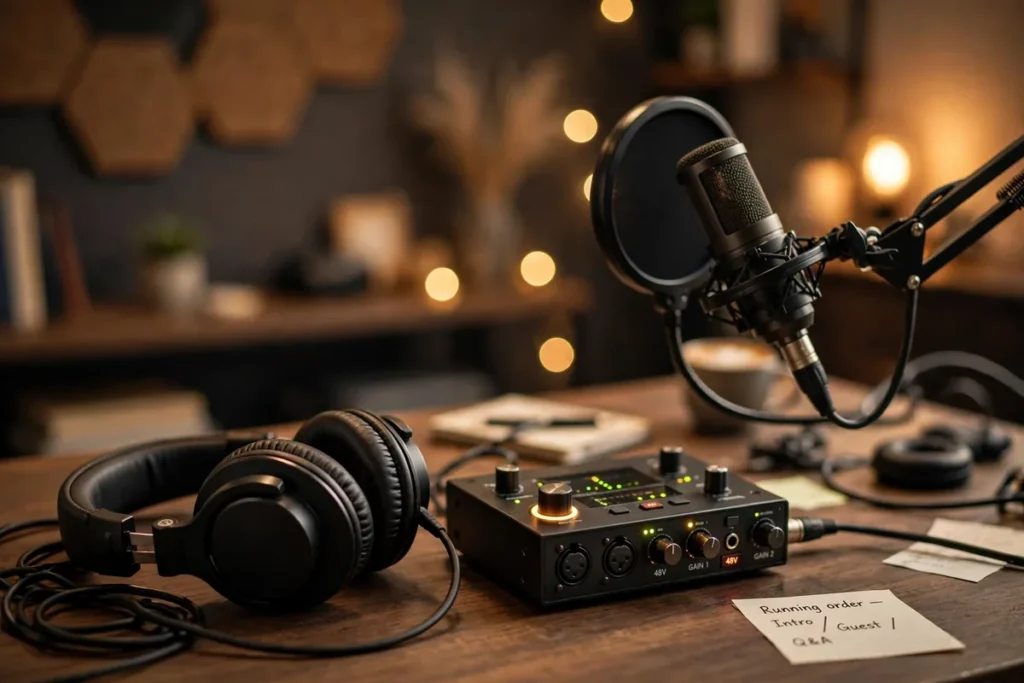
The best headphones for recording podcasts are not the ones with the longest feature list. They are closed-back studio monitoring headphones: they keep your monitor mix out of your microphone while you track, they tell you the truth about voices while you edit, and they stay comfortable through a two-hour edit session. Every pick below is a wired, closed-back monitor built for exactly that job.
One boundary up front: there are no gaming headsets and no mic-equipped models here, on purpose. When you record through an audio interface or mixer, you monitor your microphone through that hardware at zero latency, and your voice goes into the mic you chose for the show — not a boom mic bolted to an earcup. A headset mic defeats the purpose of a proper podcast chain. If you want the broader podcasting picture — guests, remote recording, listening picks — our guide to the best headphones for podcasting covers it. This page is narrower: the recording, editing, and voice-over monitoring decision.
Our Verdict — Top Picks at a Glance
Best overall for podcast recording and editing: Sony MDR-7506 — the broadcast standard. Honest midrange, zero-fuss monitoring, and a design radio and TV studios have trusted for decades.
Best for long edit sessions: Beyerdynamic DT 770 Pro (80 Ohm) — velour comfort and a spacious sound that stays easy to listen to for hours.
Best for voice accuracy: AKG K371 — a closely reference-tuned response that makes voice-over and dialogue edits translate to earbuds and car speakers.
Why Podcast Recording Needs Closed-Back Monitoring Headphones
Three jobs decide this category, and SoundMavericks’ analysis starts with the one most buying guides skip: bleed. While you record, your headphones play back your own voice, your co-host, and sometimes a click or music bed. If any of that escapes the earcups, your microphone captures it, and you get a faint echo or doubled voice baked into the take that no edit fully removes. Closed-back earcups seal that sound in. That is the entire reason studio tracking headphones look the way they do, and why open-back models — however lovely for mixing in a quiet room — are the wrong tool at the microphone. Our explainer on open-back vs closed-back headphones walks through the trade-off in detail.
The second job is honesty in the midrange. Podcast audio is voice, and voice lives roughly between 100 Hz and 8 kHz. A monitoring headphone for editing should present that range without flattery: no bass boost to hide rumble and handling noise, no treble sparkle to mask sibilance. What you hear should be what your listener gets. The third job is endurance — clamp force, earpad material, and weight decide whether you are still making good edit decisions at minute ninety. Finally, podcast gear gets knocked off desks and stuffed in bags, so replaceable cables, pads, and parts matter more here than in almost any other headphone category.
Quick Comparison: All Seven Picks Side by Side
| Headphone | Best for | Driver | Impedance | Cable | Check price |
|---|---|---|---|---|---|
| Sony MDR-7506 | Best overall | 40 mm | 63 Ω | Fixed coiled | Check Price |
| Beyerdynamic DT 770 Pro (80 Ohm) | Long edit sessions | Dynamic | 80 Ω | Fixed straight | Check Price |
| Audio-Technica ATH-M50x | Tracking + editing all-rounder | 45 mm | 38 Ω | Detachable (3 included) | Check Price |
| Sennheiser HD 280 Pro | Maximum isolation | Dynamic | 64 Ω | Fixed coiled | Check Price |
| Shure SRH840A | Critical listening | 40 mm | 40 Ω | Detachable locking | Check Price |
| Rode NTH-100 | Comfort + creator studios | 40 mm | 32 Ω | Detachable locking | Check Price |
| AKG K371 | Voice accuracy | 50 mm | 32 Ω | Detachable (3 included) | Check Price |
1. Sony MDR-7506 — Best Overall: The Broadcast Standard

If you have ever seen a photo of a radio studio, a TV location shoot, or a podcast recording in progress, you have seen the MDR-7506. Sony’s 40 mm driver, 10 Hz–20 kHz response, and 63-ohm impedance have made it the default monitoring headphone in broadcast for decades, and SoundMavericks puts it first for podcast work for one reason: its slightly forward upper midrange is ruthless with voices. Sibilance, plosives, mouth clicks, and a guest sitting too far from the mic all announce themselves immediately, which is exactly what you want while there is still time to fix them.
For tracking, the closed-back cups keep bleed where it belongs, and at roughly 230 g the 7506 disappears during a recording. The fixed coiled cable stretches across a desk without a separate extension, and the folding design with a soft case suits mobile rigs. The honest caveats: the cable is not detachable, so a cable failure is a repair rather than a swap, and the stock earpads are the wear item to budget for — replacements are cheap and widely available. As an editing headphone it rewards you with decisions that translate; as a tracking headphone it simply never gets in the way.
| Headphone | Sony MDR-7506 | Check Price |
| Frequency response | 10 Hz – 20 kHz | |
| Impedance / Sensitivity | 63 Ω / 106 dB | |
| Weight / Cable | Approx. 230 g / fixed coiled, 9.8 ft | |
2. Beyerdynamic DT 770 Pro (80 Ohm) — Best for Long Edit Sessions

Editing is where podcasts are actually made, and editing sessions run long. The DT 770 Pro earns its place on the strength of its velour earpads and roomy earcups: of everything on this list, it is the pair SoundMavericks would choose for a full afternoon of cutting interviews. The sound is a monitoring signature with a twist — a wide, spacious presentation for a closed-back design (5 Hz–35 kHz rated response), with present bass and treble detail that makes room tone, hum, and edit points easy to hear.
Choose the 80-ohm version for podcast work. It runs happily from an interface headphone output or a mixer without a dedicated amplifier, while the 250-ohm variant wants more voltage than many interfaces deliver — our guide to headphone impedance and amplifiers explains the matching. Beyerdynamic also designs the DT line for service: earpads, headband, and parts are replaceable, which suits a headphone that will live on a desk for years. The trade-offs are a fixed 3 m straight cable and a bulkier frame that is less bag-friendly than the folding designs here.
| Headphone | Beyerdynamic DT 770 Pro (80 Ohm) | Check Price |
| Frequency response | 5 Hz – 35 kHz | |
| Impedance / Sensitivity | 80 Ω / 96 dB | |
| Weight / Cable | Approx. 270 g / fixed straight, 3 m | |
3. Audio-Technica ATH-M50x — Best Tracking and Editing All-Rounder

The ATH-M50x is the most flexible headphone on this list. Its 45 mm drivers deliver a 15 Hz–28 kHz response with a low end that is fuller than a strict reference tuning — podcasters editing shows with music beds and ads will appreciate hearing that bottom octave honestly — while the midrange stays clear enough for dialogue work. Isolation is strong, the earcups swivel 90 degrees for one-ear monitoring while you adjust a guest’s mic, and the whole frame folds down for travel.
Practically, the M50x solves the cable problem better than most: three detachable cables are in the box (coiled, long straight, and short straight), so the same pair moves from interface to laptop to phone without adapters or a second purchase. At 38 ohms it is easy to drive from anything. The watch-out is clamp force: the fit is secure for tracking, but some editors find it firm in the first weeks. If your workflow splits evenly between recording and editing and you want one pair to do both, this is SoundMavericks’ all-rounder pick.
| Headphone | Audio-Technica ATH-M50x | Check Price |
| Frequency response | 15 Hz – 28 kHz | |
| Impedance / Sensitivity | 38 Ω / 99 dB | |
| Weight / Cable | 285 g / detachable, 3 cables included | |
4. Sennheiser HD 280 Pro — Best Isolation for Noisy Rooms

Not every podcast is recorded in a treated studio. If your room shares a wall with a street, a kitchen, or a household that keeps living while you record, the HD 280 Pro is the specialist: Sennheiser rates its passive attenuation at up to 32 dB, the strongest isolation claim in this roundup, and the tight seal works in both directions — less room noise reaching your ears, and less of your monitor mix reaching the mic.
The tuning (8 Hz–25 kHz, 64 ohms) is a sober monitoring response that keeps voices front and center without embellishment, which is why podcast equipment guides keep returning to it year after year. It folds, the earcups swivel, and the earpads, headband padding, and cable are replaceable. The firm clamp is the flip side of that isolation — it seals superbly, but glasses wearers and sensitive heads should expect a break-in period. For a dedicated recording-room pair, especially a guest chair, that trade is worth it.
| Headphone | Sennheiser HD 280 Pro | Check Price |
| Frequency response | 8 Hz – 25 kHz | |
| Impedance / Sensitivity | 64 Ω / 113 dB | |
| Weight / Cable | 285 g / fixed coiled | |
5. Shure SRH840A — Best for Critical Listening and Detailed Edits

Shure built its name on microphones, and the SRH840A is its argument that the other end of the chain deserves the same rigor. The updated A model keeps the original’s tailored response — 40 mm drivers, 5 Hz–25 kHz — with a refined headband and a sleeker, lower-profile build. In SoundMavericks’ assessment, this is the detail microscope of the group: breath edits, fade tails, low-level room tone, and the exact frame where a word starts are all easy to place, which makes it a strong choice for producers who do heavy post-production, audio drama, or narration cleanup.
The detachable 3 m locking cable, collapsible frame, carry case, and a spare pair of earpads in the box give it a working-studio completeness the older generation lacked. At 40 ohms it pairs with any interface. Editors who cross over into music mixing will find useful overlap with our guide to the best headphones for mixing, but for spoken-word precision the SRH840A stands on its own here.
| Headphone | Shure SRH840A | Check Price |
| Frequency response | 5 Hz – 25 kHz | |
| Impedance / Sensitivity | 40 Ω / 102 dB | |
| Weight / Cable | 273 g / detachable locking, 3 m | |
6. Rode NTH-100 — Best Modern Comfort for Creator Studios

Rode designed the NTH-100 specifically for creators — podcasters, streamers, and voice artists — rather than adapting a music headphone, and the comfort engineering shows. The earpads use a cooling gel layer under the surface fabric, the headband locks at your chosen size instead of creeping during a session, and the fit stays composed through long recordings. For hosts who record video podcasts and wear headphones on camera for hours, that matters as much as the sound.
The sound itself is a balanced monitoring tuning from custom 40 mm drivers (5 Hz–35 kHz rated, 32 ohms), with a natural midrange that flatters nothing and hides nothing in a voice. The detachable locking cable can connect to either earcup — a small detail that genuinely helps when your interface sits on one side of the desk — and Rode backs the NTH-100 with a lifetime warranty. It is the heaviest pair here at 350 g, the one spec to weigh against its comfort features if you are sensitive to weight.
| Headphone | Rode NTH-100 | Check Price |
| Frequency response | 5 Hz – 35 kHz | |
| Impedance / Sensitivity | 32 Ω / 110 dB | |
| Weight / Cable | 350 g / detachable locking, either earcup | |
7. AKG K371 — Best for Voice Accuracy and Voice-Over Work

If your podcast work leans toward voice-over, narration, or tightly produced documentary formats, the K371 is the accuracy pick. AKG tuned its 50 mm titanium-coated drivers to follow its reference response curve closely, and the audible result is a midrange that stays composed and uncolored: EQ moves you make on a voice are the EQ moves your audience hears on earbuds, laptop speakers, and car systems. That translation is the whole game in voice work.
The K371 is also the lightest full-size option here at 255 g, folds for travel between studio and home rigs, and ships with three detachable cables (3 m coiled, 3 m straight, and 1.2 m straight) plus an adapter and carry bag. Its oval, slow-retention foam pads isolate well for tracking. The build is more lifestyle-sleek than tank-like compared with the Beyerdynamic, so treat it as a precision instrument rather than a throw-in-the-bag beater — but for pure voice accuracy per session, SoundMavericks rates it at the top of this list.
| Headphone | AKG K371 | Check Price |
| Frequency response | 5 Hz – 40 kHz | |
| Impedance / Sensitivity | 32 Ω / 114 dB | |
| Weight / Cable | 255 g / detachable, 3 cables included | |
How to Choose Headphones for Recording a Podcast
Do you need closed-back or open-back headphones for podcasting?
Closed-back, for anything that happens near a live microphone. The seal prevents bleed while tracking and gives you usable isolation in imperfect rooms. Open-back headphones can serve a dedicated editing-only setup in a quiet space, but they cannot safely double as tracking headphones, which is why every pick here is closed-back.
What impedance do you need for an audio interface?
Most podcast interfaces and mixers drive 32–80 ohm headphones comfortably. Six of our seven picks sit in that window; the MDR-7506 at 63 ohms and HD 280 Pro at 64 ohms are equally easy loads. Problems only start with high-impedance studio models (250–300 ohms) on weak headphone outputs — none of our picks has that issue.
Wired or wireless for recording?
Wired, always, for monitoring. Bluetooth adds latency between your voice and your ears, which is disorienting while speaking and useless for judging timing while editing. Every headphone here connects with a cable to your interface’s headphone output, where direct monitoring is effectively instant.
How much do replaceable parts matter?
More than most buyers expect. Earpads are a wear item on any daily-use headphone, and cables fail before drivers do. Detachable-cable models (ATH-M50x, SRH840A, NTH-100, K371) and serviceable designs (DT 770 Pro, HD 280 Pro) will outlast a fixed-cable equivalent in a working studio. The MDR-7506 is the exception that proves the rule: fixed cable, but a decades-long spare-parts ecosystem behind it.
Frequently Asked Questions
What are the best headphones for recording podcasts?
For most podcasters, the Sony MDR-7506 is the best headphone for recording podcasts: closed-back isolation that prevents mic bleed, an honest midrange for editing voices, and a proven broadcast track record. The Beyerdynamic DT 770 Pro (80 Ohm) is the better pick for very long edit sessions, and the AKG K371 leads for voice-over accuracy.
Why do podcasters wear closed-back headphones while recording?
Closed-back headphones let podcasters monitor their voice through the interface without the sound leaking into the microphone. Leakage creates echo and doubled audio in the recording. The sealed design also helps the host hear mic technique problems — distance, plosives, room noise — as they happen.
Can I use gaming headsets or headphones with a built-in mic for podcasting?
You can, but it works against you. A podcast setup monitors through the audio interface and records through a dedicated microphone chosen for your voice. A headset’s boom mic replaces that microphone with a weaker one and adds nothing to monitoring quality. Dedicated monitoring headphones plus your interface and mic will sound better in every comparison.
Do I need an amplifier for podcast headphones?
Almost certainly not. Podcast monitoring headphones in the 32–80 ohm range — including every pick in this guide — run at full quality from a typical audio interface, mixer, or recorder headphone output. A separate amplifier only becomes relevant with high-impedance studio headphones.
How long should podcast headphones last?
With replaceable earpads and, where fitted, detachable cables, a good studio monitoring headphone should serve for many years of daily podcast work. Budget for earpad replacement roughly every one to two years of heavy use; the drivers themselves rarely wear out.

I am the founder of Sound Mavericks, where I provide the polite truth about audio equipment. I started this site because consumer electronics reviews are often too technical. Instead of using a silent lab, I test headphones, earbuds, and Bluetooth speakers in the real world – like on a noisy subway or in a busy coffee shop.
To stay independent, I buy my own review units (mostly from the United States) rather than accepting free gifts from brands. Once I finish testing a product, I sell it locally to our community. My goal is to help you understand sound quality, active noise cancellation (ANC), and battery life without the marketing hype.