Our Verdict: The Budget ANC Bargain That Puts Sound First
The Moondrop Space Travel does the one thing almost no ultra-budget earbud manages: it sounds genuinely well tuned. The big 13mm titanium-dome driver delivers a balanced, clear presentation, the single-feedforward ANC takes a real bite out of commuting noise, and three bass tunings in the Moondrop Link app let you bend the sound to taste. The trade-offs are equally clear — roughly four hours of battery per charge, no published water-resistance rating, and an open-top case that protects almost nothing. Forgive those, and this is still one of the strongest budget ANC buys around. SoundMavericks Score: 8.3/10.
The Moondrop Space Travel has been the worst-kept secret in budget audio since it launched. Moondrop built its name on wired in-ear monitors loved by enthusiasts, then put that tuning know-how into a true wireless earbud with active noise cancelling at the very bottom of the market. The question this review answers is simple: in 2026, with a sequel now on sale, is the original still the best budget ANC buy?
One honest note before the detail. This is a research-based review, not a hands-on lab test. We verified the Space Travel against its live Amazon US listing, cross-checked every specification against Moondrop’s published data, and weighed the wider review consensus — measurements, long-term user reports and the places where critics disagreed. Where the record is mixed, we say so. The score below is SoundMavericks’ own analysis of that evidence.
| Sound Quality | 9.0 |
| Noise Cancelling | 7.8 |
| Comfort & Design | 7.6 |
| Battery Life | 6.5 |
| Call Quality | 7.0 |
| Value | 9.5 |
Moondrop Space Travel: Full Specifications
| Specification | Moondrop Space Travel |
|---|---|
| Product | Moondrop Space Travel TWS Earphone |
| Driver | 13mm dynamic driver, titanium-plated dome composite diaphragm |
| Tuning | Moondrop VDSF target response; three bass tunings (Monitor, Reference, Basshead) via app |
| Bluetooth | 5.3, approx. 10m range; A2DP / AVRCP / HFP / HSP |
| Codecs | SBC, AAC |
| Noise cancelling | Single-feedforward wide-band ANC, up to 35dB depth (manufacturer rating), plus transparency mode |
| Battery life | About 4 hours per charge; charging case adds about 12 hours |
| Battery capacity | 37mAh per earbud; 380mAh charging case |
| Charging | USB-C; about 1 hour for the earbuds, about 1.5 hours for the case |
| Latency | 55ms low-latency game mode |
| Controls | Touch controls on each stem, customisable in the Moondrop Link app |
| Weight | About 4.2g per earbud |
| Ear tips | Silicone tips in S, M and L |
| Water resistance | No IP rating published by Moondrop |
| Buy | Check Price on Amazon |
Design and Comfort: Light, Shallow — and That Case

The Space Travel earbuds use a lollipop-style stem design with short, oval nozzles and a shallow fit — they sit at the entrance of the ear canal rather than being pushed deep into it. At about 4.2 grams per side, they are light enough to forget about, and the published consensus is that long-haul comfort is a genuine strength, especially for listeners who find deep-insertion earbuds painful. The shallow nozzle also makes these a smart pick for smaller ears, a theme we see across our guide to the best earbuds for small ears. Tip choice matters more than usual here: with S, M and L silicone tips in the box, take the time to get the seal right, because both bass and ANC depend on it.
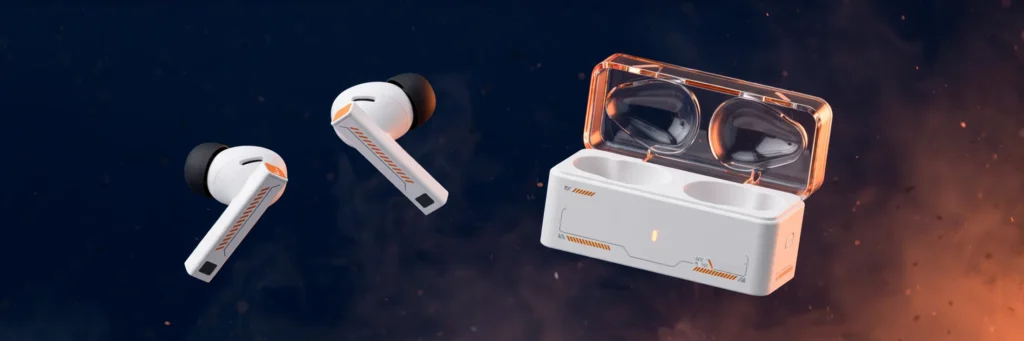
The retro space-travel styling — clear case shell, printed circuit-style graphics, an anime voice assistant (Mitsuki Yuki) announcing your connection — gives the Space Travel more personality than any rival at this level. Whether that personality is for you is a taste call. The voice prompts are part of it: instead of saying “ANC on,” the buds greet transparency mode with a cheery “Hey!” and ANC with a “Shhh.” Reviewers found them charming or confusing in roughly equal measure; either way, you learn them within a day.
The open-top case is the design’s weak point
There is no way to sugar-coat the case: it has no lid. The earbuds slide into two open slots under a transparent cover panel, which looks great on a desk and does almost nothing to protect them in a bag — buds can work loose, dust and lint get in, and nothing stands between the earbuds and a spilled drink. The USB-C port also sits on the bottom, so the case cannot stand upright while charging. If you are rough on your gear, this case will annoy you daily; treat it as a desktop dock that travels reluctantly.
How Does the Moondrop Space Travel Sound?
This is the section the Space Travel was built to win. The 13mm dynamic driver — unusually large for a true wireless earbud — uses a titanium-plated dome composite diaphragm and is tuned to Moondrop’s VDSF target response. Measurements in the published review record show a response that tracks a sensible consumer preference curve closely through the bass and mids, with treble that extends cleanly without turning sharp. In plain language: these sound balanced, clear and easy to listen to for hours, where most budget rivals sound boomy, thin or harsh within a single album.
Bass, mids and treble
Bass is tight and controlled rather than skull-rattling. Kick drums have snap, bass lines stay textured, and the low end does not bleed into vocals the way it does on cheaper buds. Mids sit very slightly back in the default Reference tuning, giving music a relaxed, spacious feel — the soundstage is wider than expected at this level, and busy orchestral or layered pop passages stay sorted instead of collapsing into mush. Vocals come through crisp and natural, highs are clear without glare, and the overall timbre is the most natural documented in this price class. The one recurring caveat is maximum volume: some listeners wanted one more step of loudness.
Three bass tunings, no EQ homework
Instead of a full custom EQ, the Moondrop Link app offers three bass tunings — Monitor, Reference and Basshead — and the consensus is that all three are well judged. Reference is the balanced default and the one most listeners should stay on. Monitor trims the bass for a flatter, more analytical listen, while Basshead adds the low-end weight that hip-hop and EDM listeners will want. It is a simpler system than a graphic EQ, but it covers the changes most people actually make, and it means the Moondrop Space Travel never needs app-fiddling to sound right out of the box.
How Well Does the Moondrop Space Travel Cancel Noise?
Moondrop rates the ANC at up to 35dB of wide-band reduction, and the engineering choice behind it is interesting: where most budget ANC buds use a hybrid feedforward-plus-feedback design, the Space Travel uses a single feedforward system. Moondrop’s reasoning is that a feedback microphone inside the front cavity can eat into the bass, forcing extra compensation filtering — so it skipped feedback entirely to protect the sound. Independent measurements in the published record show real-world attenuation in the region of 20dB across much of the range, which will not trouble flagship earbuds but is excellent for this class. If you want the science of how that anti-noise trick works, our explainer on how noise cancelling headphones work covers it.
In practice, steady low-frequency noise — bus and train rumble, air-conditioning, office hum — drops well into the background, mid-range sounds like keyboard clicks and chatter are softened, and music becomes easier to focus on at lower volume. Sharp, irregular sounds still get through. Transparency mode emphasises the vocal band, so announcements and quick conversations come through clearly, though it is a basic implementation rather than the natural, open sound of premium buds. Wind is the ANC’s enemy — reviewers noted it can emphasise wind noise outdoors, in which case switching ANC off is the better listen.
Battery Life: The Honest Weakness
Moondrop rates the Space Travel at about four hours of playback per charge, with the 380mAh case adding roughly twelve more hours. Independent lab testing in the published record landed just over that mark — about four hours and twenty minutes in a standardised test — so the claim is honest. It is still, bluntly, the weakest battery result in the class. Plenty of budget rivals now run six to eight hours per charge, and four hours will not cover a long-haul flight leg or a full workday without a case break.
For commuting and a few hours of desk listening, four hours is workable, and the small batteries charge quickly — about an hour for the buds, ninety minutes for the case. But if battery life is your top priority, this is not your earbud; our roundup of the best noise cancelling earbuds includes longer-legged alternatives. Frequent charging cycles also mean the tiny cells will age faster, the hidden cost of the design.
Moondrop Link App and Touch Controls
Each stem carries a touch panel: a single tap plays or pauses, a double tap skips tracks (previous on the left, next on the right), a triple tap summons your voice assistant, a long press cycles noise control between ANC, transparency and off, and four taps switch into the 55ms low-latency game mode, which genuinely tightens audio delay for mobile gaming and video. Reviewers found the panels mostly responsive, occasionally finicky. The buds also reconnect automatically when removed from the case and switch seamlessly between single-bud and stereo use.
The Moondrop Link app is where you switch bass tunings, customise what each tap and long press does, and manage the voice prompts. Core features all work without it, which is just as well: the app is the most criticised part of the package in the review record, described as basic and occasionally crash-prone, and Android users in particular have had a bumpier ride with it than iPhone users. Our advice mirrors the consensus — install it once, set your tuning and controls, then forget it exists. The one thing you will not find anywhere in the package is Bluetooth multipoint: the Space Travel connects to one device at a time.
Can You Use the Moondrop Space Travel for Phone Calls?
Yes — with the expectations set correctly. The Space Travel carries microphones on each earbud and, indoors or in a quiet office, voices come through clearly enough that published microphone polling rates call quality mostly “okay” to “good.” Where it struggles is exactly where every budget bud struggles: the mics offer limited rejection of surrounding noise, room echo is not well suppressed, and wind on a street call will push your voice into the background. For desk calls, quick check-ins and voice notes, it does the job. If your day is back-to-back outdoor calls, spend more on a model built for it — our guide to the best noise cancelling earbuds for phone calls is the right place to look.
Moondrop Space Travel vs Space Travel 2: Should You Upgrade?
A sequel exists, and search interest in “moondrop space travel vs space travel 2” is real, so here is the short version. The Space Travel 2 updates the formula with newer Bluetooth and revised DSP tuning, while the Space Travel 2 Ultra goes further with a planar driver and LDAC support. On paper that sounds like a straightforward upgrade — but at least one major review outlet expects more listeners to prefer the original’s tuning, and the original remains on sale on Amazon US at the time of writing. If you already own the Space Travel and like how it sounds, nothing in the sequel is a must-have: the reasons to switch are battery, connectivity and case design, not a leap in audio quality.
Pros and Cons
Pros
- Best-in-class tuning — balanced, clear, natural sound
- Real ANC that noticeably cuts commuting noise
- Three well-judged bass tunings in the app
- Shallow, light fit that suits small ears
- 55ms game mode for low-latency mobile gaming
- Standout retro design and personality
Cons
- Only about 4 hours of battery per charge
- Open-top case offers almost no protection
- No published IP water-resistance rating
- App is basic and occasionally unstable
- No multipoint connection; SBC and AAC only
- Microphones struggle in wind and noise
Who Should Buy the Moondrop Space Travel?
Buy the Space Travel if sound quality per dollar is your priority and your listening happens in sessions of a few hours — commutes, study blocks, desk work, casual mobile gaming. It is an especially good first ANC earbud, and a natural pick for smaller ears that find deep-fitting buds uncomfortable. Skip it if you need all-day battery, if you run or train outdoors in all weather (there is no IP rating to hide behind), if you take lots of calls outside, or if your earbuds live loose in a bag where that open case will suffer. Everyone else gets the rare budget product whose compromises are all in the packaging, not in the sound.
Frequently Asked Questions
Does the Moondrop Space Travel have good noise cancelling?
For its class, yes. Moondrop rates the single-feedforward wide-band ANC at up to 35dB depth, and independent measurements show around 20dB of real-world attenuation. It is very effective on steady noise like engines, fans and office hum, less so on sharp, sudden sounds — and it will not match flagship ANC earbuds.
How long does the Moondrop Space Travel battery last?
About 4 hours per charge from the earbuds, with the 380mAh charging case adding roughly 12 more hours. The earbuds recharge in about an hour and the case in about 1.5 hours over USB-C. It is the weakest part of the package compared with longer-lasting budget rivals.
Is the Moondrop Space Travel good for phone calls?
It handles indoor and quiet-environment calls well, with voices rated mostly okay to good in published microphone tests. Outdoors it offers limited noise and wind rejection, so frequent street callers should look at earbuds with stronger call processing.
Are the Moondrop Space Travel earbuds good for small ears?
Yes. The shallow fit, short oval nozzles and light 4.2g build make them one of the more comfortable budget options for smaller ears. Choosing the right tip size from the included S, M and L sets is important for both comfort and ANC performance.
Moondrop Space Travel vs Space Travel 2: which should you buy?
The Space Travel 2 adds newer Bluetooth and revised DSP tuning, and the 2 Ultra adds a planar driver and LDAC. The original, however, has a proven, well-measured tuning that some reviewers still prefer. Buy the original for the sound value; consider the sequel for its newer connectivity and features.
Does the Moondrop Space Travel work with iPhone and Android?
Yes. It connects over Bluetooth 5.3 with SBC and AAC codecs, so it pairs with iPhone, Android phones, tablets and computers. The Moondrop Link app unlocks the three bass tunings and custom touch controls, but the earbuds’ core features work without it.
Final Verdict
The Moondrop Space Travel remains the budget ANC earbud that embarrassed the class on sound. Its tuning is measured, documented and genuinely enjoyable, its ANC does real work on a commute, and its three bass presets cover most listeners without EQ homework. The battery, the lidless case and the missing IP rating are real flaws — but no alternative at this end of the market sounds this good. If your priorities start with the music, the Space Travel earns its 8.3/10 and its place on any budget shortlist.

I am the founder of Sound Mavericks, where I provide the polite truth about audio equipment. I started this site because consumer electronics reviews are often too technical. Instead of using a silent lab, I test headphones, earbuds, and Bluetooth speakers in the real world – like on a noisy subway or in a busy coffee shop.
To stay independent, I buy my own review units (mostly from the United States) rather than accepting free gifts from brands. Once I finish testing a product, I sell it locally to our community. My goal is to help you understand sound quality, active noise cancellation (ANC), and battery life without the marketing hype.