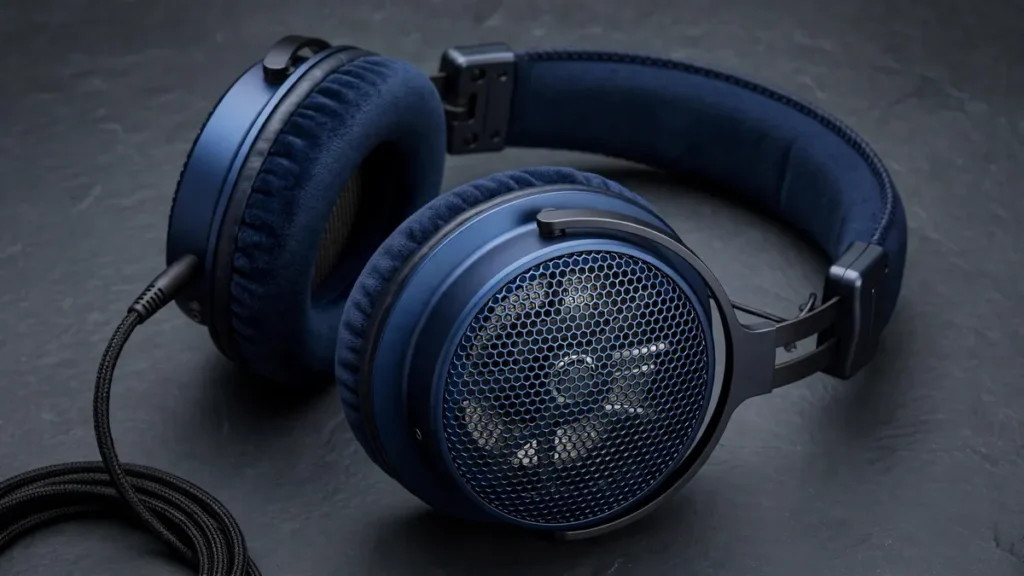
The Beats Studio Pro wireless noise canceling headphones are the flagship over-ears Beats built to answer a simple question: can a style-first headphone also be a serious noise cancelling headphone? On published specifications and verified listing data, the answer is mostly yes. You get fully adaptive active noise cancelling, personalised spatial audio with dynamic head tracking, USB-C lossless audio, and up to 40 hours of battery life in a folding design that weighs just 260 grams. This Beats Studio Pro review works through the verified specification, the sound signature, the noise cancelling, the comfort trade-offs, and the head-to-head that matters most — Beats Studio Pro vs AirPods Max — so you can decide whether these are the right premium headphones for how you actually listen.
The Beats Studio Pro are the most complete Beats over-ears yet: lively, balanced sound with real low-end weight, competent fully adaptive ANC, class-leading cross-platform support for both iPhone and Android, and a USB-C lossless mode most rivals simply do not offer. Noise cancelling and long-session comfort sit a step behind the very best from Sony and Bose, and there is no wear detection or in-app EQ. For Apple and Android users who want one headphone that does almost everything well, they earn a strong recommendation.
Best for: iPhone and Android users who want spatial audio, long battery life and wired lossless listening in one folding headphone.

Beats Studio Pro Specifications
Start with the verified specification, because the Studio Pro’s spec sheet explains most of its appeal. A custom 40mm driver sits in each ear cup, tuned — according to Beats — for a balanced profile with low distortion across the frequency curve, a deliberate step away from the bass-at-all-costs tuning older Beats models were known for. Connectivity is unusually complete: Bluetooth 5.3 with Class 1 range, USB-C audio with a built-in digital-to-analogue converter for lossless listening, and a 3.5mm analogue input for flights and legacy gear. Six microphones handle noise cancelling, transparency and voice pickup. The full breakdown is below, and if you are still narrowing down the category itself, our guide to the best noise cancelling headphones shows where the Studio Pro sit in the wider field.
| Specification | Beats Studio Pro | Buy |
|---|---|---|
| Product | Beats Studio Pro Wireless Noise Cancelling Headphones | Check Price |
| Driver | Custom 40mm drivers | Check Price |
| Noise cancelling | Fully adaptive ANC with Transparency mode | Check Price |
| Battery life | Up to 24 hours (ANC on), up to 40 hours (ANC off) | Check Price |
| Fast charging | Fast Fuel: 10-minute charge adds up to 4 hours | Check Price |
| Bluetooth | Bluetooth 5.3, Class 1 range | Check Price |
| Codecs | AAC, SBC (no aptX or LDAC over Bluetooth) | Check Price |
| Wired audio | USB-C lossless audio (up to 24-bit/48kHz) and 3.5mm input | Check Price |
| Spatial audio | Personalised Spatial Audio with dynamic head tracking | Check Price |
| Microphones | 6 microphones (ANC, transparency and voice targeting) | Check Price |
| Weight | 260g | Check Price |
| Colours | Black, Sandstone, Navy, Deep Brown | Check Price |
| Water resistance | None — not rated for sweat or rain | Check Price |
Sound Quality: Balanced, With the Bass Still Present
The headline change from the Studio3 generation is restraint. Published measurements and reviewer consensus describe a tuning that keeps Beats’ characteristic low-end energy but pulls it back enough for vocals and instruments to breathe. Bass is deep and punchy on hip-hop and EDM without swamping the midrange, mids come through clear enough for podcasts and acoustic material, and treble stays clean rather than sharp. It is a fun, mainstream-friendly signature rather than a flat studio reference — listeners who want forensic detail will still prefer a dedicated audiophile tuning, but for the pop, R&B, electronic and film content most people actually play, the balance here is well judged.
Two features lift the Studio Pro above a standard Bluetooth listen. Personalised Spatial Audio with dynamic head tracking, set up through a compatible iPhone, widens supported Dolby Atmos music and film into a genuinely three-dimensional presentation that moves with your head. And over USB-C, the built-in DAC unlocks lossless listening up to 24-bit/48kHz with three built-in sound profiles, bypassing Bluetooth compression entirely. That wired mode is a real differentiator: neither the Sony nor Bose flagships in this class offer USB audio listening in the same way. The trade-off is codec support over Bluetooth — AAC and SBC only, with no LDAC or aptX — which matters most to Android listeners with hi-res libraries. If that is your priority, our Beats Studio Pro vs Sony WH-1000XM5 comparison breaks down exactly what LDAC buys you.
Noise Cancelling and Transparency Mode
The Studio Pro use a fully adaptive ANC system that continuously samples your surroundings and adjusts its filtering in real time. On the published evidence, it handles the steady low-frequency noise that matters most — jet engines, train rumble, air conditioning, office hum — very effectively, and it clearly improves on the Studio3 it replaces. The honest framing, which comparative testing from outlets such as SoundGuys supports, is that it sits a tier below the class leaders: Sony’s and Bose’s flagship systems suppress a broader slice of mid and high-frequency noise, such as nearby voices, more completely. For commuting, open-plan offices and most flights, the Studio Pro’s cancelling is more than sufficient; for the quietest possible cabin on long-haul routes, the flagships keep an edge.
Transparency mode is the pleasant surprise. It passes outside sound through naturally, without the thin, echoed quality cheaper implementations suffer from, so holding a conversation or hearing a platform announcement does not require taking the headphones off. Switching between ANC and Transparency is a single button press on the ear cup, and physical controls throughout — rather than touch gestures — keep operation reliable with gloves on or mid-workout.
Design, Comfort and Build
Beats kept the silhouette the brand is known for: clean lines, a prominent logo, folding ear cups and a slim fabric-covered carrying case that actually fits in a bag. At 260 grams the Studio Pro are noticeably lighter than Apple’s metal-heavy flagship, which pays off over a working day. The UltraPlush leatherette cushions are softer and more supportive than the Studio3’s pads, and the clamp force that keeps them stable on the move is the same force some listeners report as pressure on larger heads after a couple of hours. That is the Studio Pro’s most consistent comfort caveat in owner feedback: superb for commutes and desk sessions of an hour or two, worth a cautious fit check if your typical session runs much longer or you wear glasses with thick frames.
Build quality is competent rather than luxurious. The chassis is mostly plastic — which is how the weight stays low — with metal in the sliders and hinges where durability actually counts. There is no water or sweat resistance rating, so despite the secure fit, these are not gym headphones in any official sense; treat them as travel and everyday headphones and they will last. The generational jump is worth seeing in full in our Beats Studio 3 vs Studio Pro comparison, which covers the USB-C switch, the new drivers and the improved call processing in detail.
Battery Life and Charging
Battery life splits by mode: up to 24 hours with ANC or Transparency on, and up to 40 hours with noise control switched off. In mixed everyday use that translates to charging roughly once a week rather than once a day, and Beats’ Fast Fuel charging remains one of the most useful quick-top-up systems in the class — ten minutes plugged in returns up to four hours of playback, enough to rescue a forgotten charge before a commute. Charging is over USB-C, finally retiring the older generation’s port, and because the USB-C connection also carries audio, desk listeners can charge and listen losslessly at the same time, which effectively removes battery anxiety on workdays entirely.
Context matters here. Sony’s flagships publish around 30 hours with ANC on, so if maximum ANC-on endurance is your single deciding metric, they hold a paper advantage. The Studio Pro’s counter is flexibility: the 40-hour ANC-off figure, the fast top-up, and the wired lifeline if Bluetooth is restricted or the battery is flat. For most real routines — a few hours a day across music, calls and video — either figure is comfortably sufficient.
Calls, Controls and Cross-Platform Features
Voice-targeting microphones isolate your speech and suppress background noise during calls, with Beats claiming up to 27 percent clearer voice pickup than the Studio3 generation. Owner and reviewer reports put call quality solidly in the good-for-its-class band: clear in offices and moderately busy streets, with wind remaining the usual enemy of every over-ear microphone array. For routine remote meetings and phone calls from public spaces, the Studio Pro are entirely serviceable.
The cross-platform story is where the Studio Pro genuinely lead the premium class. iPhone users get one-touch pairing, iCloud device switching, hands-free Siri, Find My support and personalised spatial audio. Android users are not treated as second class: Google Fast Pair, Audio Switch between devices, and Find My Device support are all built in, with the Beats app handling settings and firmware on both platforms. Very few premium headphones serve both ecosystems this evenly. Two omissions are worth knowing before you buy: there is no wear detection, so music does not auto-pause when you lift an ear cup, and there is no adjustable EQ in the app — the sound signature you get is the sound signature Beats chose, USB-C profiles aside.
Beats Studio Pro vs AirPods Max: Are They Better?
This is the comparison the Studio Pro invite, because they borrow so much of Apple’s playbook — spatial audio, Find My, seamless iPhone pairing — in a lighter, folding, cross-platform package. The table below uses published specifications for both. Our dedicated Beats vs AirPods Max breakdown goes deeper on the wider line-up.
| Feature | Beats Studio Pro | Apple AirPods Max |
|---|---|---|
| Product | Beats Studio Pro — Check Price | Apple AirPods Max — Check Price |
| Battery (ANC on) | Up to 24 hours | Up to 20 hours |
| Weight | 260g, folds flat with case | 385g, does not fold |
| Wired audio | USB-C lossless and 3.5mm included | No 3.5mm input on the original model |
| Android support | Fast Pair, Audio Switch, Find My Device | Basic Bluetooth only |
| Build | Plastic with metal sliders | Aluminium and steel, premium feel |
| Spatial audio | Personalised, head-tracked | Personalised, head-tracked |
So, are they better than the AirPods Max? For most people, on balance, yes — with one clear exception. The Studio Pro win on battery life, weight, portability, wired flexibility and Android support, and they deliver the same headline Apple features, including head-tracked spatial audio and Find My. The AirPods Max counter with a more premium metal build, a wider and more refined soundstage in comparative reviews, and noise cancelling that edges the Beats. If you live entirely inside Apple’s ecosystem, prize build quality above portability, and rarely travel with your headphones, the Max still justify themselves. If you commute, travel, switch between iPhone and a Windows or Android device, or simply want the lighter bag, the Studio Pro are the smarter buy — and Beats’ own line now extends further, as our Beats 360 vs Beats Studio Pro comparison shows.
Pros and Cons
Pros
- Lively, balanced sound with personalised spatial audio and head tracking
- USB-C lossless audio plus 3.5mm — wired flexibility rivals lack
- Up to 40 hours battery (ANC off) and Fast Fuel 10-minute top-ups
- Best-in-class dual support for iPhone and Android ecosystems
- Lightweight 260g folding design with a genuinely portable case
- Natural-sounding Transparency mode and clear physical controls
Cons
- ANC is strong but a step behind Sony and Bose flagships
- No wear detection or auto-pause, and no in-app EQ
- Clamp force can cause pressure on longer sessions for some listeners
- No LDAC or aptX Bluetooth codecs, and no water resistance rating
| Sound Quality | 8.7 |
| Noise Cancelling | 8.2 |
| Comfort & Design | 8.0 |
| Battery Life | 8.8 |
| Call Quality | 8.1 |
| Value | 8.5 |
Final Verdict: Who Should Buy the Beats Studio Pro?
The Beats Studio Pro succeed because they stopped trying to be only a fashion statement. The verified package — balanced 40mm-driver sound, fully adaptive ANC, spatial audio, USB-C lossless, 40-hour maximum battery life and equal treatment for iPhone and Android — makes them one of the most versatile premium over-ears available. Buy them if you want one headphone for commuting, travel, desk work and films, especially across mixed devices. Look at Sony or Bose instead if class-leading noise cancelling is your single priority, and look at the AirPods Max if premium metal build and Apple’s ecosystem depth matter more than weight and portability. For everyone in between, the Studio Pro are an easy recommendation.
Frequently Asked Questions
Are the Beats Studio Pro better than the AirPods Max?
For most listeners, yes on practical grounds: the Studio Pro are lighter (260g vs 385g), fold for travel, last longer per charge, add USB-C lossless and 3.5mm wired audio, and work fully with Android. The AirPods Max offer a more premium metal build and a slightly more refined soundstage, so the better choice depends on whether portability and flexibility or build and ecosystem depth matter more to you.
How long does the Beats Studio Pro battery last?
Beats rates the Studio Pro at up to 24 hours with noise cancelling or Transparency on, and up to 40 hours with noise control off. Fast Fuel charging adds up to four hours of playback from a ten-minute charge.
Do the Beats Studio Pro work with Android?
Yes — unusually well for an Apple-owned product. Android users get Google Fast Pair, Audio Switch between devices, Find My Device support and the Beats app for settings and firmware updates, alongside standard Bluetooth audio.
Can you use Beats Studio Pro wired?
Yes, two ways. USB-C carries lossless digital audio up to 24-bit/48kHz with three built-in sound profiles, and a 3.5mm cable is included for analogue sources such as in-flight entertainment systems.
Are the Beats Studio Pro good for phone calls?
Yes for everyday use. Six microphones with voice targeting keep speech clear in offices and moderately busy environments, an improvement Beats rates at up to 27 percent clearer voice pickup over the Studio3. Strong wind remains a weakness, as with most over-ear headphones.
Do the Beats Studio Pro have an EQ?
There is no adjustable EQ in the Beats app. You get Beats’ fixed tuning over Bluetooth, plus three built-in sound profiles when listening over USB-C. Listeners who want deep sound customisation should consider Sony’s flagships instead.

I am the founder of Sound Mavericks, where I provide the polite truth about audio equipment. I started this site because consumer electronics reviews are often too technical. Instead of using a silent lab, I test headphones, earbuds, and Bluetooth speakers in the real world – like on a noisy subway or in a busy coffee shop.
To stay independent, I buy my own review units (mostly from the United States) rather than accepting free gifts from brands. Once I finish testing a product, I sell it locally to our community. My goal is to help you understand sound quality, active noise cancellation (ANC), and battery life without the marketing hype.