

Picture this: You just bought a pair of high-end audiophile headphones. You read the reviews, you saved up the money, and you finally unboxed them. You plug them into your laptop, put on your favorite track, and crank the volume to 100%.
The result? A whisper-quiet disappointment.
The bass sounds weak. The vocals feel distant. You check your settings, but everything is maxed out. You didn’t buy a broken product; you just hit the Impedance Wall.
In the world of audio, Impedance is one of those scary specifications that confuse almost everyone. It is measured in Ohms, and it usually sits right next to Frequency Response on the box. But while most people ignore it, Impedance is actually the single most important number for figuring out if your headphones will sound amazing—or barely make a sound at all.
We are going to explain what Ohms mean for your wallet and answer the ultimate question: Do I need to buy an amplifier?
The Short Answer
If you are in a rush and just want to know if you need to buy extra gear, here is the quick breakdown. Look at the spec sheet on your headphone box and find the number next to the ohm symbol.
- Under 32 Ohms: No Amp Needed. These are designed for smartphones, laptops, and game controllers. They will sound great straight out of the box.
- 32–80 Ohms: The Grey Zone. These will work fine with most computers, but they might sound a bit quiet on a phone. An inexpensive amplifier will make them sound better, but it is not strictly required.
- Over 100 Ohms: Amp Strongly Recommended. If you plug these into a phone, the volume will be very low. You need a dedicated amplifier to hear what you paid for.
A Critical Note: An amplifier isn’t just about making things louder. It is about control. Think of it like a car engine. You can drive a sports car in first gear (low power), but the ride will be jerky and rough. Giving high-impedance headphones more power makes the bass tighter and the details sharper.
How Impedance Actually Works
To understand Impedance without a degree in electrical engineering, we need to use the classic Water Pipe Analogy.
Imagine electricity is water flowing through a garden hose.
- Voltage (The Source): This is the water pressure coming from the tap (your phone or amp).
- Current (The Music): This is the actual water flowing through the hose.
- Impedance (The Nozzle): This is the resistance. It determines how hard it is to push the water through.
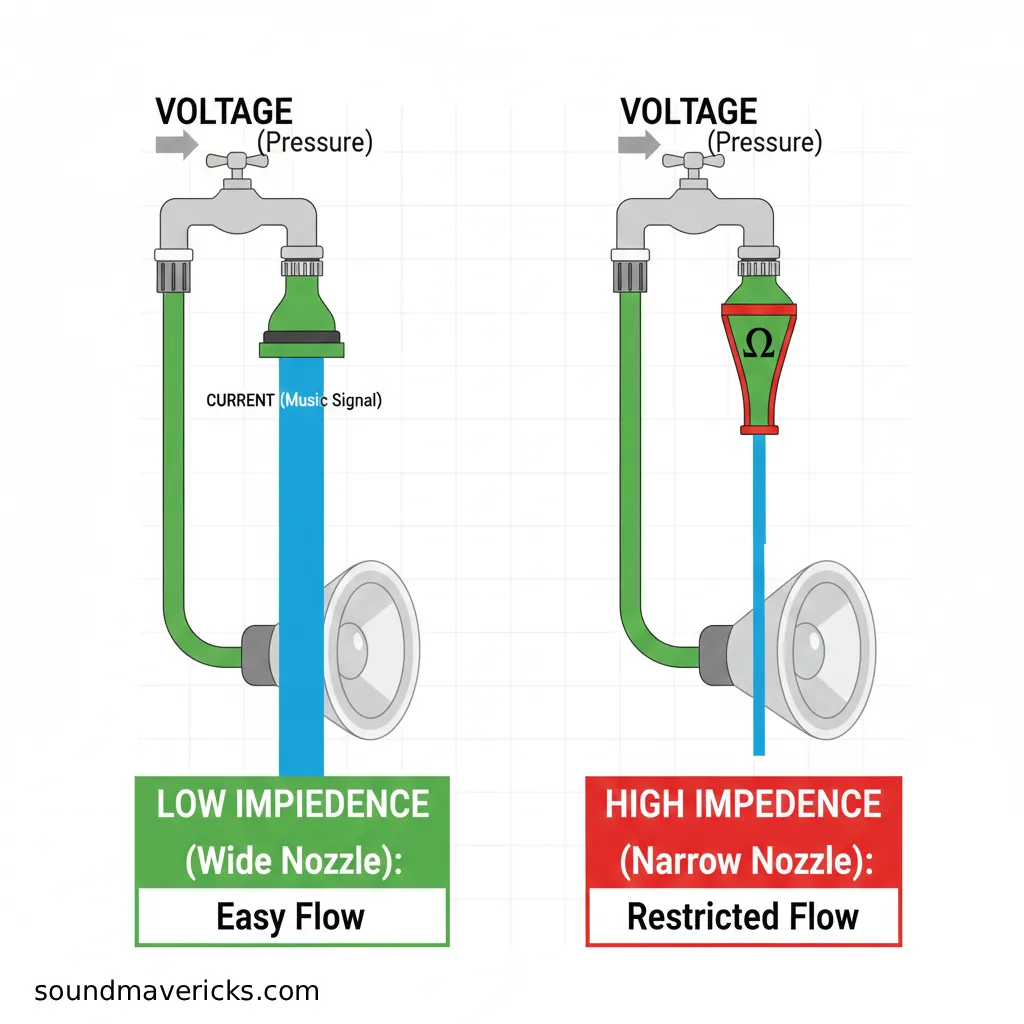
Low Impedance Headphones (The Wide Nozzle)
Headphones with low impedance (usually under 50 Ohms) act like a hose with a very wide, open nozzle.
Because the nozzle is wide, you don’t need much water pressure (Voltage) to get a lot of water (Current) flowing. This is why you can plug standard earbuds into a smartphone, which has a weak battery and low voltage, and still get loud sound.
- The Benefit: They are efficient and easy to use anywhere.
- The Downside: Because they let electricity flow so easily, they also pick up garbage signals easily. If you plug sensitive, low-impedance in-ear monitors into a powerful, noisy amplifier, you might hear a constant background hiss. This is called the noise floor.
High Impedance Headphones (The Narrow Nozzle)
Headphones with high impedance (100, 250, or even 600 Ohms) act like a hose with a very narrow, tight nozzle.
If you connect this narrow nozzle to a weak garden tap (your phone), the water will just trickle out. There isn’t enough pressure to force it through. To get a strong stream, you need a high-pressure fire hose (an Amplifier).
- The Benefit: Why would anyone want this? High impedance usually means the manufacturer used thinner, lighter wire in the voice coil (the engine of the speaker). A lighter coil can move back and forth much faster than a heavy one. This results in better detail, clearer treble, and a more natural sound.
- The Cost: You simply cannot run these off a battery-powered device. You need the high voltage of a dedicated amp.
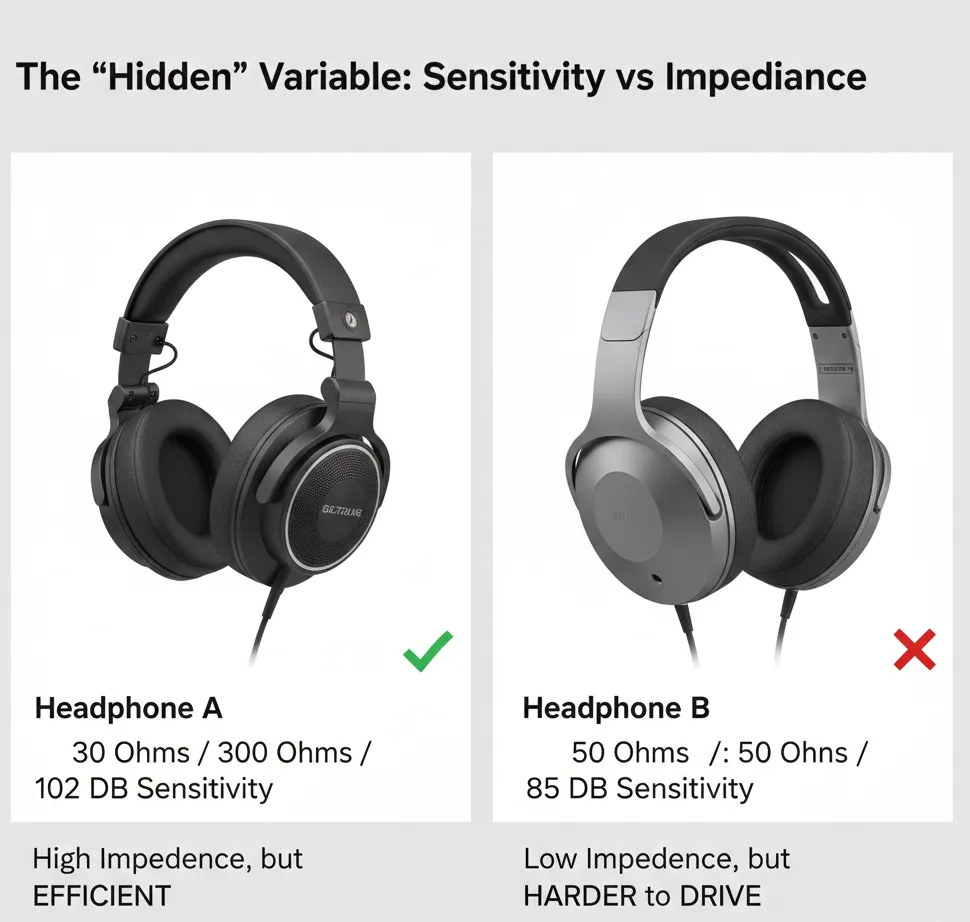
The Hidden Variable: Sensitivity vs. Impedance
Here is where many people get tricked. They see a headphone with low Impedance and assume it is easy to drive. This is not always true.
You must also look at Sensitivity (measured in dB). This number tells you how loud the headphones get with a specific amount of power.
Let’s look at two examples:
- Headphone A: 300 Ohms / 102 dB Sensitivity.
- Headphone B: 50 Ohms / 85 dB Sensitivity.
Logic suggests Headphone A needs an amp because of the high Ohms. But actually, Headphone B is harder to drive.
Think of Sensitivity as the weight of the car, and Impedance as the transmission. Even if Headphone B has a transmission built for easy driving (low Ohms), the car is so heavy (low sensitivity) that you still need a massive engine to move it.
The Maverick Rule: If the Sensitivity is below 95 dB, you probably need an amp, regardless of what the Impedance says.
Real World Scenarios: When to Upgrade
Still unsure? Let’s look at three common situations. If you recognize yourself here, it is time to open your wallet.
Scenario A: The Quiet at Max Volume Issue
You are on a plane or a bus. You have your volume slider at 100%. You can still hear the engine noise or the person talking next to you clearly over your music.
- Diagnosis: Your source (phone) lacks the Voltage to push past the resistance of your headphones.
- The Fix: Buy a portable amplifier or a DAC/Amp dongle.
Scenario B: The Muddy Bass Issue
The volume gets loud enough, so you think you are fine. But when the beat drops, the bass sounds flabby, distorted, or weak. The drums don’t kick; they thud.
- Diagnosis: This is a current issue. Your headphones are asking for a burst of energy to reproduce that bass note, but your phone cannot deliver it fast enough. The sound wave clips or flattens out.
- The Fix: A dedicated amp provides a reservoir of power that can deliver instant energy for those bass hits.
Scenario C: The Hissing Issue
You plugged expensive in-ear monitors (IEMs) into your nice desktop computer. When the music pauses, you hear a static shhhhh sound.
- Diagnosis: Your headphones have too little impedance. They are picking up the electronic noise from your computer’s motherboard.
- The Fix: Ironically, you need to add resistance. You can buy a device like an iEMatch that artificially adds impedance to clean up the signal.
The Buying Guide: Matching Gear
You don’t need to spend thousands to solve these problems. Here is what you should look for based on your listener type.
1. The Commuter (Earbuds / Bluetooth)
If you use wireless headphones (like Sony WH-1000XM5 or AirPods), ignore everything in this article.
Bluetooth headphones have their own tiny amplifiers built inside the earcups. The engineers have already perfectly matched the amp to the drivers. You cannot add an external amp to Bluetooth headphones.
2. The Gamer (32–50 Ohms)
Most gaming headsets are tuned to be efficient. You can plug them directly into your PS5 controller or PC motherboard.
- Do you need an amp? No.
- Exception: If you want Surround Sound features, a gaming DAC (like the Sound Blaster G6) helps, but that is for software processing, not power.
3. The Aspiring Audiophile (80–250 Ohms)
You own headphones like the Beyerdynamic DT 770 (80 Ohm version) or Sennheiser HD 560S.
- Do you need an amp? Maybe.
- The Gear: Start with a Dongle DAC. These look like USB-C adapters but have powerful audio chips inside. They are cheap (under $50) and usually provide enough kick for this category.
4. The Pro (300–600 Ohms)
You own the Sennheiser HD 600/650 or high-end planar magnetics.
- Do you need an amp? Yes. Without one, you are wasting your money.
- The Gear: You need a Desktop Stack. This sits on your desk and plugs into the wall. Brands like Schiit Audio, FiiO, or iFi make excellent entry-level stacks that will drive almost anything.
FAQ: Common Questions
Historically, yes. High-impedance headphones were the standard for studios because they allowed for more detail. However, modern technology is changing this. Many new Planar Magnetic headphones have very low impedance but sound incredible. Don’t buy high impedance just because you think bigger number = better. Buy it because you have the right amp to support it.
Yes. If you take sensitive, low-impedance earbuds and plug them into a high-powered desktop amplifier set to High Gain, you can blow out the drivers. Always start with the volume at zero and turn it up slowly.
It won’t explode. It won’t break. It will just sound very quiet, thin, and lifeless. You won’t hear the deep bass or the sparkling treble. It is safe to try, but it won’t be enjoyable.

I am the founder of Sound Mavericks, where I provide the polite truth about audio equipment. I started this site because consumer electronics reviews are often too technical. Instead of using a silent lab, I test headphones, earbuds, and Bluetooth speakers in the real world – like on a noisy subway or in a busy coffee shop.
To stay independent, I buy my own review units (mostly from the United States) rather than accepting free gifts from brands. Once I finish testing a product, I sell it locally to our community. My goal is to help you understand sound quality, active noise cancellation (ANC), and battery life without the marketing hype.